
Why Is My AC Not Cooling? Top Causes and Solutions for Jeddah Homes
You set the thermostat to 22°C, the unit hums to life, and… nothing. The air coming out is room temperature at best. In Jeddah, that’s not a minor inconvenience — it’s a problem that needs an answer within the hour, not the week. The good news is that “AC not cooling” almost always traces back to one of a small, predictable set of causes, and most of them give off warning signs before the system fails completely.
This guide breaks down exactly why your AC has stopped cooling, in the order we see it happen most often across Jeddah homes and businesses — from villas in Al Aziziyah to retail units in Al Muhammadiyah. For each cause, you’ll get a plain-English explanation, a way to check it yourself in minutes, and an honest verdict on whether it’s safe to fix yourself or whether it needs a licensed technician.
A word of caution before you start: some of the checks below are completely safe — pulling a filter, checking a breaker, swapping a battery. Others involve refrigerant lines or live electrical components, and those genuinely aren’t DIY territory, no matter how confident you feel with a screwdriver.
If you’d rather have someone diagnose it properly today, AC Repair Service In Jeddah covers the full city, including Al Basateen, Al Murjan, Al Zahraa, Al Naim, Al Nahda, Al Khalidiyah, Al Shati, and both Obhur districts. You can book a diagnostic visit here whenever you’re ready to stop guessing.
What separates a genuine diagnosis from a guess is simple: a technician who actually measures the system, rather than one who assumes the most common cause and hopes for the best. That distinction matters even more in Jeddah, where a misdiagnosed AC can mean days of unnecessary heat while the real fault keeps getting worse in the background.
By the end of this guide, you’ll be able to narrow down the likely cause yourself before anyone even shows up at your door, whether you’re troubleshooting a villa in Al Aziziyah or a storefront unit in Al Muhammadiyah.
Core Introduction to AC Not Cooling Problems in Jeddah
An AC that’s “not cooling” is really an AC that’s failed at one specific step in a four-part process: compressing refrigerant, releasing heat outdoors, expanding the refrigerant, and absorbing heat indoors. When any one of those steps breaks down, the symptom looks the same to you — warm air — even though the actual cause could be electrical, mechanical, or simply dirt-related.
That’s exactly why guessing rarely works. A homeowner who assumes “it must need gas” and pays for a refrigerant top-up when the real issue was a dirty filter ends up with the same warm air and a wasted service call. Understanding the real chain of causes, in order of likelihood, saves you both time and money. If you’re dealing with a different symptom altogether — noises, leaks, or an AC that won’t turn on — our guide to the 10 most common AC problems in Jeddah homes covers those separately.
Why This Matters for Jeddah Homeowners and Businesses
An AC not cooling properly in Jeddah isn’t just uncomfortable — during summer months, indoor temperatures can climb dangerously fast once cooling stops, especially in west-facing units in districts like Al Zahraa and Al Nahda that catch the harshest afternoon sun. For small business owners in areas like Al Muhammadiyah, a warm shop or clinic isn’t just a comfort issue either; it affects customers, staff, and sometimes temperature-sensitive stock.
Property managers overseeing multiple units face a compounded version of this problem, since one “not cooling” complaint often signals a pattern worth checking across similar units installed around the same time. Local heat and humidity accelerate nearly every cause on this list, which is why the same fault tends to develop faster here than in milder regions.
A Real-World Scenario: What We See On the Ground
In our field experience, a fairly typical AC not cooling call came from a small clinic in Al Muhammadiyah where the unit had been running without cooling for two days before anyone called. The staff assumed the unit was simply too old and had already started pricing replacements.
On inspection, the actual cause was a capacitor that had partially failed — still spinning the fan, but not with enough force to keep the compressor cycling properly. A straightforward capacitor swap, done in under 30 minutes, restored full cooling. What looked like “the whole system dying” was one small, inexpensive part — not a full replacement. This mismatch between assumed cause and actual cause is something we see constantly.
How Cooling Failure Actually Develops
Refrigerant enters the compressor as a low-pressure gas and leaves as a high-pressure, high-temperature gas. It then moves to the outdoor condenser coil, where it releases that heat to the outside air and turns into a liquid. From there, it passes through an expansion valve, drops in pressure and temperature, and enters the indoor evaporator coil as a cold liquid ready to absorb heat from your room air.
Any interruption in that cycle — a leak dropping refrigerant volume, a dirty coil blocking heat transfer, an electrical fault stopping the compressor from cycling correctly — breaks the loop at a specific point. Diagnosing “not cooling” is really just figuring out which of these four stages failed.
The Initial Phase: Where Cooling Failures Start
Almost every cooling failure we investigate started as something smaller: slightly weaker airflow, a slightly longer run time to reach the same temperature, or a faint sound that wasn’t there a month earlier. These early signs are the system’s way of telling you a component is drifting out of spec before it fails outright.
The problem is that Jeddah’s heat masks this progression. A system running 20% harder than it should still produces cool air for weeks before the strain causes an actual breakdown, which is exactly why so many “sudden” failures aren’t sudden at all once you look at the history.
The Execution Phase: How a Small Issue Becomes No Cooling At All
Once a small issue goes unaddressed, it typically compounds through one of two paths. Either restricted airflow or refrigerant leads to ice formation on the evaporator coil, which then blocks airflow even further in a worsening loop, or electrical strain from overworking a failing component causes that component to fail completely, stopping the cycle at that exact stage.
Both paths end the same way: a system that runs, sounds normal in some cases, and produces zero meaningful cooling. By the time you notice completely warm air, the underlying issue has usually been building for days or weeks already.
Technical Specifications: A Deeper Look
Technicians diagnosing a “not cooling” complaint typically start with a delta-T check — measuring the temperature difference between the air entering the return vent and the air leaving the supply vent. A healthy split system usually shows roughly an 8–11°C drop across that measurement; a reading well outside that range points to a real fault rather than normal variation.
From there, checks move to refrigerant pressures against manufacturer specification, amperage draw on the compressor, and capacitor microfarad readings. Each of these narrows down which of the four refrigeration cycle stages is actually failing, rather than guessing based on symptoms alone.
Core Benefits and ROI of Diagnosing It Quickly
Every day a system runs while genuinely faulty adds strain to components that weren’t designed for that stress. A capacitor limping along at reduced output, for instance, forces the compressor to draw more current just to start, which shortens the compressor’s own lifespan in the process.
There’s also a comfort and safety dimension unique to Jeddah’s climate. A home or business that loses cooling entirely during peak summer isn’t just uncomfortable — indoor temperatures can climb to genuinely unsafe levels within hours, which makes same-day diagnosis less of a luxury and more of a basic necessity here.
Financial and Time-Saving Advantages
Diagnosing the real cause the day symptoms appear is almost always cheaper than waiting. A capacitor or filter issue caught early is a short, low-cost visit. The same issue left to run for weeks can take out a compressor, turning a small repair into a major one.
Time matters just as much. A same-day technician visit with the right diagnostic tools typically identifies the actual cause within 30 to 60 minutes. Without that, homeowners often cycle through guesses — a filter change here, a refrigerant top-up there — losing days of comfort while the real cause goes untouched.
A Specific Metric Worth Knowing
Saudi Arabia’s minimum energy efficiency standards for AC units have climbed significantly over the years — the Saudi Energy Efficiency Center notes that minimum efficiency ratings for split-type units have risen from roughly 7.5 up to around 11.8 since 2007, with window units following a similar upward path. That matters here because an older, lower-efficiency unit that’s also suffering from one of the faults in this guide is often losing cooling capacity from two directions at once: outdated technology and an active fault.
That combination is why older units in Jeddah sometimes seem to “give up” faster than the same fault would cause in a newer, more efficient system.
Top Causes of AC Not Cooling Problems in Jeddah
These are the specific faults behind the large majority of “not cooling” calls we handle across Jeddah, ordered by how often we encounter each one rather than by severity. Work through them roughly in order, since the earlier causes are also the easiest and cheapest to rule out yourself.
A note on how to read these: each entry includes what’s actually happening inside the system, a way to check it in a few minutes, and an honest answer on whether it’s safe DIY territory or a job that needs certified equipment.
1. Dirty or Clogged Air Filter
A filter thick with Jeddah’s fine dust chokes off airflow across the evaporator coil, which means less heat gets pulled from the air before it’s pushed back into your room. This is consistently the single most common cause behind a “not cooling” complaint, and also the cheapest to fix.
Quick check: Hold the filter up to a light source. If you can’t see light passing through clearly, it’s overdue. Fix it yourself? Yes — this is genuinely one of the best DIY wins available, and during peak dust season, checking every two to four weeks beats a standard quarterly schedule.
2. Low Refrigerant From a Leak
Refrigerant is a closed-loop substance — a system running low always means a leak somewhere in the coil, line set, or a fitting, not normal “usage.” Without a full charge, the system can’t absorb heat efficiently at the indoor coil, leaving the air only slightly cooler than room temperature.
Quick check: Compare the two copper lines at the outdoor unit — one should feel distinctly colder. Ice on the indoor coil or line set is another strong indicator. Fix it yourself? No. Locating and sealing a refrigerant leak requires certified equipment and training, full stop.
3. Frozen Evaporator Coil
Ice on the coil sounds contradictory for a “not cooling” problem, but it’s one of the most frequent findings on inspection. It usually starts from restricted airflow or a low refrigerant charge, both of which drop the coil’s surface temperature low enough that condensation freezes instead of draining normally.
Quick check: If accessible, look for visible ice on the coil or heavy frost on the refrigerant lines outside. Fix it yourself? Turn the unit off and allow it to thaw fully, which can take several hours — never chip at the ice. A technician still needs to identify what caused the freeze in the first place.
4. Dirty Condenser Coil on the Outdoor Unit
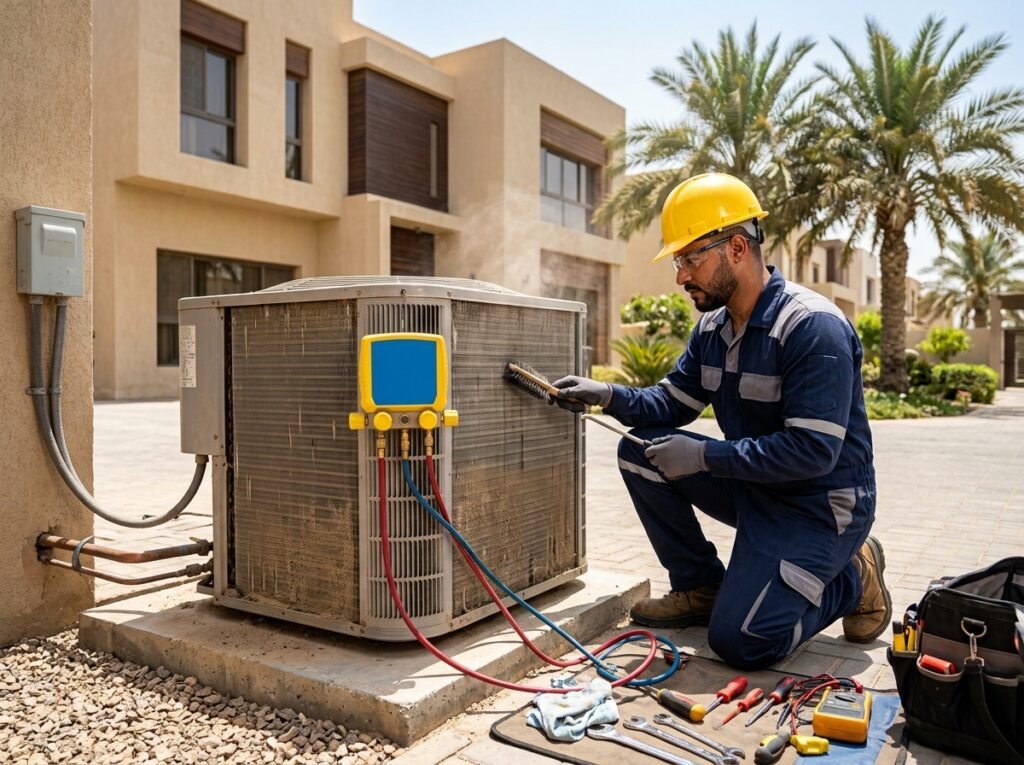
The outdoor unit’s entire job is releasing the heat pulled from inside your home. A coil coated in dust, or salt residue common in coastal districts like Al Shati and Obhur Al Shamaliyah, can’t shed that heat efficiently, so cooling capacity drops across the whole system even though nothing has technically broken.
Quick check: Inspect the fins for visible buildup or a gray film across the coil surface. Fix it yourself? A gentle hose rinse with the power off is safe DIY maintenance. A full chemical coil flush is better left to a professional, especially on systems that haven’t been cleaned in over a year.
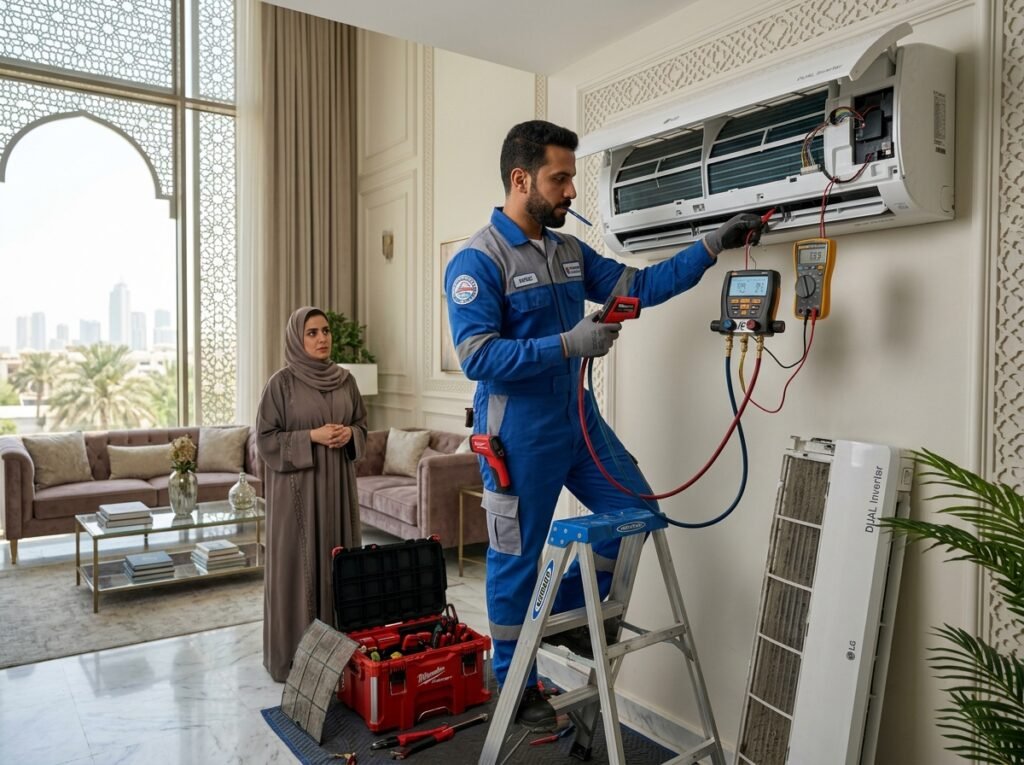
5. Failed or Weakening Capacitor
The run capacitor supplies the initial power surge the compressor and outdoor fan need to start and keep running smoothly. Jeddah’s sustained high temperatures shorten capacitor lifespan considerably, since heat is one of the primary factors that degrades these components over time.
Quick check: A humming outdoor unit with a fan that isn’t spinning, or spinning weakly, is the classic capacitor symptom. Fix it yourself? No. Capacitors store an electrical charge even when the system is powered off, and handling them without proper discharge procedures is a genuine safety risk.
6. Electrical Faults Beyond the Capacitor
Contactors, relays, and control boards can all fail in ways that stop the compressor from engaging properly, even when the fan runs normally. These faults are less common than a capacitor issue but produce a similar symptom: airflow without meaningful cooling.
Quick check: If the indoor fan runs but the outdoor unit stays completely silent, an electrical fault beyond the capacitor is worth suspecting. Fix it yourself? No. Diagnosing which specific electrical component failed requires testing equipment and training that go well beyond a visual check.
7. Thermostat Miscommunication
Occasionally the AC unit itself is functioning correctly, but the thermostat isn’t relaying commands properly — dead batteries, a loose low-voltage wire, or a smart thermostat that’s lost its Wi-Fi connection can all make a healthy system appear broken.
Quick check: Replace the batteries first if applicable, then confirm the display responds when you adjust the set temperature. Fix it yourself? Battery swaps and basic resets are safe. Wiring issues behind the wall plate should go to a technician to avoid damaging the control board.
8. Unit Undersized or Nearing End of Life
Sometimes there’s no single failed part — the unit is either too small for the space it’s cooling, or it’s old enough that its overall capacity has genuinely declined. Both produce the same complaint: the AC runs constantly and never quite reaches the set temperature, especially during peak afternoon heat.
Quick check: If the system never stops running yet consistently underperforms, even right after maintenance, sizing or age is worth investigating. Fix it yourself? No. This requires a proper load assessment and an honest conversation about repair versus replacement.
Choosing the Right AC Diagnostic Professional in Jeddah
Diagnosing an AC not cooling issue correctly depends heavily on whether the technician actually tests the system or just guesses based on the most common cause. The difference between a five-minute filter check and a proper delta-T and pressure test is the difference between a real fix and a repeat call next week.
Ask directly what tools they bring to a diagnostic visit. A technician who shows up with a manifold gauge set and a digital thermometer is set up to actually measure the problem, not just inspect it visually and guess.
Key Credentials or Features to Look For
Prioritize technicians certified across major brands common in Jeddah homes and businesses, including LG, Samsung, and Hitachi. Confirm they use genuine manufacturer parts, since generic substitutes tend to fail faster under this climate’s combination of heat and humidity.
Same-day diagnostic availability matters more here than almost anywhere else, given how quickly indoor temperatures climb once cooling stops completely. Transparent pricing that separates the diagnostic fee from any repair cost is another strong signal you’re dealing with a trustworthy provider rather than one padding the bill.
Crucial Evaluation Questions to Ask Before Hiring
A short phone call before booking can save you from a frustrating, expensive misdiagnosis. These five questions cover what most homeowners forget to ask until after the visit.
| Question to Ask | Why It Matters |
|---|---|
| Do you measure delta-T and refrigerant pressure, or just inspect visually? | Confirms an actual diagnostic process rather than a guess. |
| Is the diagnostic fee credited toward the repair cost? | Prevents paying twice for the same visit. |
| Do you provide a written explanation of the root cause? | Protects you from vague answers like “it needed gas.” |
| Are your technicians certified for my AC’s brand? | Reduces the risk of an incorrect part being installed. |
| Do you guarantee the repair if the same fault returns? | Shows accountability if the diagnosis turns out wrong. |
AC Not Cooling? Understanding Diagnostic and Repair Costs
Pricing for a “not cooling” repair varies enormously depending on the actual cause, which is exactly why any quote given before inspection is a guess rather than a real number. What you can rely on is understanding the cost structure, so nothing on the final invoice comes as a surprise.
Most invoices break down into three parts: the diagnostic visit itself, the parts required once the cause is confirmed, and the labor to complete the repair. A capacitor or filter-related fix sits at the low end. A refrigerant leak repair or electrical component replacement sits considerably higher, given the specialized tools and time involved.
Breakdown of Base Costs
The diagnostic fee covers the technician’s time and tools to actually identify the fault — this is typically the smallest line item, even though it’s the most important step. Parts pricing varies enormously between a low-cost item like a capacitor and a major component like a compressor.
Labor is usually billed by job complexity rather than a flat rate, since a capacitor swap and a full refrigerant leak repair involve very different skill and time requirements. Always ask for these three components listed separately so you can see exactly where your money is going.
Hidden Fees or Unexpected Costs
Emergency same-day visits during summer heatwaves often carry a premium over standard scheduling — confirm this before booking if your call falls outside normal business hours. Refrigerant type also affects cost, since older R-22 systems are generally pricier to service than newer R-410A units given the phase-out of R-22 production.
Warranty coverage is worth checking too. If your unit is still under manufacturer warranty, having a non-authorized technician handle certain repairs can void that coverage entirely, turning what looked like the cheaper option into a costly mistake.
Pro Tip for Saving Money
Don’t wait until the AC has fully stopped cooling to call someone. If you’ve noticed weaker airflow, longer run times, or a new sound over the past week or two, booking a diagnostic visit at that stage almost always costs less than waiting for a complete failure, since the underlying fault hasn’t had time to damage anything else yet.
This is especially true for capacitor issues, which tend to give a week or two of warning humming before failing outright — that window is the cheapest possible time to fix it.
Step-by-Step Diagnostic Guide: What to Check Before Calling
Working through a clear sequence before you call saves time and helps the technician arrive prepared, especially if you can describe exactly what you’ve already ruled out. It also protects the system from further strain while you figure out what’s actually wrong.
Start with the simplest possibilities. A meaningful share of “not cooling” calls resolve with nothing more than a breaker reset, a clean filter, or confirming the thermostat is actually set to cool rather than fan-only.
What to Do First
Check the electrical panel for a tripped breaker and reset it once — if it trips again immediately, stop and call a technician rather than resetting repeatedly, since that pattern usually signals a real electrical fault. Next, pull the filter and inspect it, then confirm the thermostat is set correctly and responding to input.
If none of that resolves it, check the outdoor unit for visible issues: is the fan spinning, are the coils clean, and is there any humming without movement. Turn the system off if you spot ice anywhere, rather than letting it keep running in a faulty state.
Tools and Information to Have Ready
Have your AC’s brand, approximate age, and model number ready if visible on the nameplate, since this speeds up diagnosis considerably. Note exactly when the “not cooling” symptom started and whether it came on gradually or suddenly.
A basic flashlight helps you inspect the filter and outdoor coil yourself before the visit. If you’re a property manager or business owner, having the unit’s install or last-service date on hand helps the technician build a faster, more accurate picture of the fault.
Expert Strategies for Maximum Cooling Performance
Set your thermostat to a realistic 24–25°C rather than pushing it unnecessarily low — every additional degree below that adds compressor strain without a proportional comfort gain, and it accelerates wear on every component covered in this guide.
Keep the outdoor unit’s surroundings clear of furniture, plants, or storage that restricts airflow around the coil, particularly in villa properties across Al Aziziyah and Al Basateen where outdoor units often sit in tight side yards. Schedule a delta-T and pressure check twice a year rather than waiting for symptoms, since several of the causes above give measurable early warning long before you’d notice warm air by feel alone.
Top Mistakes Homeowners Make With AC Not Cooling Problems
The most damaging habits aren’t dramatic — they’re small delays and assumptions repeated over and over: assuming it “just needs gas,” ignoring a new sound, and letting a system run for days in a clearly faulty state instead of shutting it down.
Each of these turns a manageable fault into a bigger one through simple repetition rather than any single dramatic error. None of them require special knowledge to avoid, just a willingness to act on the first sign of trouble. Below is the single mistake we see most often, and exactly how to avoid it.
Mistake 1: Cranking the Thermostat Lower When It’s Not Cooling
When the air isn’t cold enough, the instinctive reaction is to push the thermostat down further, assuming the system just needs to “try harder.” In reality, this does nothing to fix the underlying fault and can actively worsen a developing coil freeze, since the compressor keeps running against the same restricted airflow or low refrigerant charge.
How to prevent it: If lowering the thermostat doesn’t produce colder air within a few minutes, stop adjusting it and start troubleshooting instead. Continuing to lower the setting only adds unnecessary runtime to a system that’s already struggling.
Maintenance, Longevity, and Long-Term Cooling Reliability
A system that receives consistent, basic care rarely experiences a sudden “not cooling” failure — most of the causes in this guide give warning signs that consistent maintenance catches early. In Jeddah’s climate, that gap between maintained and neglected systems widens faster than almost anywhere else in the region.
Longevity here isn’t about expensive upgrades. It’s about a handful of small habits performed consistently rather than reactive fixes after something breaks, and most of them cost nothing more than a few minutes of attention.
Daily and Weekly Best Practices
Check that vents and the area around the outdoor unit stay clear of dust buildup, stored items, or blockages that restrict airflow. During particularly dusty stretches, a quick visual check of the filter every week takes under a minute and catches problems before they affect cooling.
Pay attention to run time. If the system suddenly takes noticeably longer to reach your set temperature than it did the week before, that’s worth investigating immediately rather than waiting to see if it resolves on its own.
Insider Hack for Long-Term Cooling Success
Keep a simple note on your phone every time a technician visits — what was found, what was replaced, and the date. Over a year or two, this turns vague memories into a real maintenance history, which makes it obvious if the same fault keeps recurring.
A recurring fault despite proper repairs is often a sign of a deeper issue, like incorrect original installation or a unit that’s genuinely undersized, and having dates on hand makes that conversation with your technician far more productive.
Comparing Alternative Options: Repair vs Replace
When a “not cooling” diagnosis points to something serious — a failing compressor, a unit near the end of its typical lifespan, or a system that’s chronically undersized — homeowners face a real choice between repairing the specific fault and replacing the unit entirely.
The right call depends on the unit’s age, how the repair cost compares to a full replacement, and whether this is an isolated fault or part of a repeating pattern. A relatively young unit with one clear, fixable cause almost always favors repair.
Traditional Repair vs Full System Replacement
Repairing a specific fault — a capacitor, a refrigerant leak, an electrical component — is generally the faster and more affordable path when the rest of the system is in reasonable condition. It also means less disruption, since most repairs are completed same-day.
Full replacement makes more sense when a unit is old, has a history of repeat faults, or when the specific repair cost approaches a significant share of what a new, more efficient unit would cost. Newer inverter-driven units also tend to modulate output more precisely, which can reduce the kind of strain that causes some of the faults in this guide.
Why Diagnosis-First Usually Wins
Jumping straight to replacement without a proper diagnosis means you might be replacing a unit that only needed one small, inexpensive part. Insisting on a real diagnosis first — not just a visual guess — is what separates an unnecessary full-system decision from an accurate one, whichever direction it ends up pointing.
This is where the diagnostic questions from earlier in this guide pay off directly. A technician willing to explain exactly which of the four cooling stages failed, and why, is one you can trust to recommend replacement only when it’s genuinely the better option.
Geographic, Legal, and Compliance Rules for AC Systems in Jeddah
Air conditioners installed in Saudi Arabia fall under national energy performance and building regulations, which matters most when a “not cooling” diagnosis points toward full replacement rather than repair. Even repairs on an existing unit are worth checking against these standards, since some upgrades only make sense if the replacement parts meet current requirements too.
Understanding these basics helps you confirm that any replacement unit meets current requirements, rather than simply matching what was already installed. It’s a small check that pays off over the full lifespan of a new system.
Navigating Saudi Energy and Building Regulations
The Saudi Standards, Metrology and Quality Organization (SASO) sets minimum energy performance and labeling requirements for AC units sold in the Kingdom under standard SASO 2663, using a Seasonal Energy Efficiency Ratio (SEER) rating system that has become significantly stricter over the past decade. Separately, the Saudi Building Code’s energy conservation requirements (SBC 601 for commercial buildings, SBC 602 for residential) govern HVAC design standards in new construction and major renovations.
If your diagnosis leads toward replacement, confirming the new unit carries a current SASO energy label is a simple way to ensure it meets today’s efficiency requirements rather than outdated ones. You can check current requirements directly on SASO’s official portal.
Essential Safety and Risk Mitigation Protocols
Never attempt refrigerant handling or electrical component replacement yourself — both carry genuine safety risks and require certified equipment most homeowners simply don’t have access to. Always disconnect power at the breaker, not just the thermostat, before any hands-on inspection.
For units on shared balconies or near neighboring properties, confirm that any condensate drainage or outdoor unit placement doesn’t create a hazard or dispute with neighbors, which is a common oversight in Jeddah’s denser residential districts. It’s an easy detail to overlook during a repair, but an awkward one to fix after the fact.
Conclusion and Summary
AC not cooling problems almost always come down to one of eight identifiable causes, from a simple dirty filter to a genuinely failing compressor. The pattern behind nearly every expensive repair we see is the same: a small warning sign that got ignored for too long.
Catching the cause early — through a proper diagnostic process rather than a guess — is consistently the cheapest and fastest path back to reliable cooling. That’s true whether the fix turns out to be a five-minute filter swap or a conversation about replacing an aging system.
Final Recap of What You’ve Learned
You now understand the eight most likely reasons your AC has stopped cooling, which checks are safe to try yourself, and which genuinely require a licensed technician with the right tools. You also know how pricing typically breaks down, what questions separate a real diagnosis from a guess, and how basic maintenance prevents most of these faults from happening in the first place. Most importantly, you know that acting on early warning signs is almost always cheaper than waiting for a complete breakdown.
Next Steps: Book a Real Diagnosis in Jeddah
If your AC is running but not cooling right now, don’t spend another day guessing. AC Repair Service In Jeddah sends technicians equipped for real diagnostics — not just visual guesses — across the entire city, including Al Muhammadiyah and Al Aziziyah.
You can book a diagnostic visit directly through their website and get a straight answer on what’s actually wrong, rather than a guess dressed up as a repair. Whether the fix turns out to be a five-minute capacitor swap or a bigger conversation about replacement, knowing the real cause first is what saves you time and money either way.
Frequently Asked Questions
Top 5 Questions Jeddah Homeowners Ask
1. Why is my AC running but blowing warm air? An AC not cooling despite running normally points to a break somewhere in the refrigeration cycle — most often a dirty filter restricting airflow, a low refrigerant charge from a leak, or a dirty outdoor coil that can’t release heat properly. Start with the filter, since it’s the easiest and cheapest to rule out yourself.
2. My AC was cooling fine yesterday and stopped suddenly — what happened? Sudden-seeming failures are usually the final stage of a smaller issue that had been building for days or weeks, most commonly a capacitor weakening or ice forming on the evaporator coil. What feels sudden to you rarely is to the system.
3. Is it bad to keep running my AC if it’s not cooling? For a short period while you do basic checks, it’s generally fine. But if you notice ice on the coil, a burning smell, or a humming outdoor unit with a fan that isn’t moving, turn it off immediately and call a technician rather than letting it run in that state.
4. Can I just add refrigerant myself to fix warm air? No. A system low on refrigerant has a leak, and simply adding more without finding and sealing that leak only delays the same problem while wasting money. Refrigerant handling also requires certified equipment that isn’t available to homeowners.
5. How do I know if I need a repair or a full AC replacement? If this is an isolated, clearly identified fault on a relatively young unit, repair is almost always the better value. If the unit is older, has failed repeatedly, or the repair cost approaches a large share of a new system’s price, replacement deserves serious consideration.
Final Bonus Tip for Every Jeddah Homeowner
The next time your AC feels even slightly less cold than usual, don’t wait for it to become a full emergency. Book a quick check that same week — most causes in this guide are dramatically cheaper to fix at the first sign of trouble than after a full breakdown during the next heatwave.
Final Thoughts: An AC that’s not cooling is almost never unsolvable — it’s a specific, identifiable fault somewhere in a four-stage cooling cycle, and most causes give warning signs before they escalate. The key is acting on those signs early and insisting on a real diagnosis instead of a guess. For fast, transparent, and properly diagnosed AC repair anywhere in Jeddah, AC Repair Service In Jeddah is ready to help — reach out through their booking page whenever cooling stops being reliable.