
10 Common AC Problems in Jeddah Homes and How to Fix Them Fast
If your AC just gave up on a Jeddah afternoon, you already know how fast a cool home turns into an oven. Common AC problems in Jeddah homes almost always trace back to the same handful of causes: relentless heat, thick coastal humidity, fine airborne dust, and salt air chewing away at outdoor units near the coast. None of that is your fault. It’s just what this city does to a machine that runs nearly nonstop from April through October.
This guide walks through the 10 issues we see most often on service calls across Jeddah — from Al Basateen and Al Aziziyah to Al Shati and Obhur Al Shamaliyah. For each one, you’ll get the likely cause, a way to check it yourself in under five minutes, and an honest answer on whether it’s a DIY fix or a job for a licensed technician.
A quick note before you dive in: some of these fixes are genuinely safe to try yourself, like clearing a filter or resetting a breaker. Others involve refrigerant, high-voltage capacitors, or sealed electrical components, and trying to force those yourself can turn a small, affordable repair into a major, expensive one. We’ll flag which is which as we go.
If you’d rather skip the troubleshooting and just get someone out today, AC Repair Service In Jeddah sends certified technicians across the city, including Al Muhammadiyah, Al Murjan, Al Zahraa, Al Naim, Al Nahda, Al Khalidiyah, and Obhur Al Janoubiyah. You can reach the team directly through their booking page whenever you’re ready.
What makes Jeddah different isn’t just the heat — it’s heat, humidity, and dust hitting a system that rarely gets a real break to recover. A unit that might last a decade in a drier climate can show serious wear years earlier here if it’s never properly maintained. That’s why so many “sudden” breakdowns homeowners describe aren’t sudden at all; they’ve been building quietly for months.
Whether you’re in a villa in Al Murjan or an apartment near Al Khalidiyah, the steps below apply the same way. Work through them in order, and you’ll know within minutes whether this is a DIY fix or one that needs a professional today.
Core Introduction to Common AC Problems in Jeddah Homes
An air conditioner in Jeddah works harder than almost anywhere else in the region. Outdoor temperatures regularly climb past 40°C in summer, and humidity often sits between 55% and 65% along the coast, forcing the compressor and evaporator coil to fight heat and moisture at once. That constant strain is why AC problems here tend to show up earlier and more often than in drier, cooler climates.
Most breakdowns aren’t random. They follow a slow build-up: a dirty filter restricts airflow, the system runs longer to compensate, and components fail months or years ahead of schedule. Understanding that chain is the first step toward catching problems before they turn into a full breakdown on the hottest day of the year.
Why This Matters for Jeddah Homeowners
Homeowners in districts like Al Basateen, Al Nahda, and Al Khalidiyah run their AC nearly around the clock for six to seven months a year. That’s a very different duty cycle than a system in a milder climate ever sees. Coastal neighborhoods such as Al Shati, Obhur Al Shamaliyah, and Obhur Al Janoubiyah add another layer: salt-laden air speeds up corrosion on outdoor condenser coils, fins, and electrical contacts.
Dust is the other constant. Jeddah’s air carries fine particulate that settles into filters and coils faster than most manufacturers’ maintenance schedules assume. Skipping even one seasonal cleaning here can do the damage of a full year elsewhere. That’s why local expertise matters more than a generic repair manual.
A Real-World Scenario: What We See On the Ground
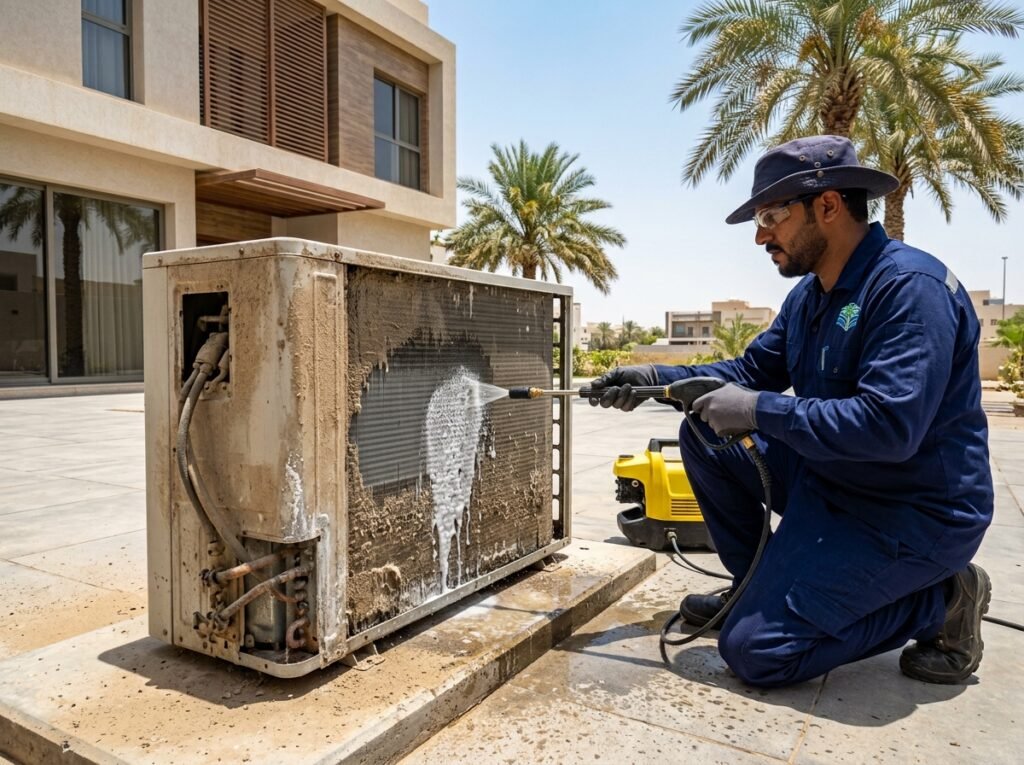
In our field experience, a fairly typical call goes like this: a homeowner in Al Naim reports their split AC “just stopped cooling” on a Thursday evening. On arrival, the outdoor unit is running, but there’s a thin film of dust caked across the condenser fins thick enough to block airflow almost completely.
The fix wasn’t a new part. It was a proper coil flush and a filter swap, and the system was back to blowing cold air within the hour. What could have been read as “the AC is dying” was really just routine maintenance that had been pushed back one season too many. We see this pattern constantly, especially in homes that haven’t had a professional cleaning in over a year.
How These AC Problems Actually Develop
Every AC failure follows a process, not a random event. Warm, moist air gets pulled across the evaporator coil, heat and humidity get extracted, and the resulting cool air gets pushed back into your rooms. Refrigerant carries that heat outside, where the condenser coil and compressor release it into the outdoor air.
When any single stage in that loop gets restricted — a blocked filter, a dirty coil, a low refrigerant charge — the rest of the system has to compensate. That compensation is what eventually burns out compressors, trips capacitors, and drives your electricity bill up long before the unit fully fails.
The Initial Phase: Early Warning Signs
The earliest signals are almost always airflow and sound related, not total failure. A slightly weaker breeze from the vents, a faint musty smell when the AC first kicks on, or a soft rattle from the outdoor unit are the system telling you something’s off before it actually breaks down.
Most homeowners in Jeddah dismiss these signs during peak summer because the AC is technically still cooling. That’s exactly the window where a quick, low-cost filter clean can prevent a major, high-cost compressor repair down the line. Catching a warning sign in week one is dramatically cheaper than catching it in month three.
The Execution Phase: What Happens When You Ignore Them
Left unaddressed, restricted airflow forces the compressor to run longer cycles at higher pressure just to hit the same thermostat setting. That extra strain heats up internal components, degrades refrigerant oil, and accelerates wear on bearings and windings that were built for normal duty, not constant overtime.
Eventually, one of two things happens: the compressor seizes, or an electrical component like the run capacitor fails from repeated overheating. Both are fixable, but a compressor replacement can cost several times more than the maintenance that would have prevented it in the first place.
Technical Specifications: A Deeper Look
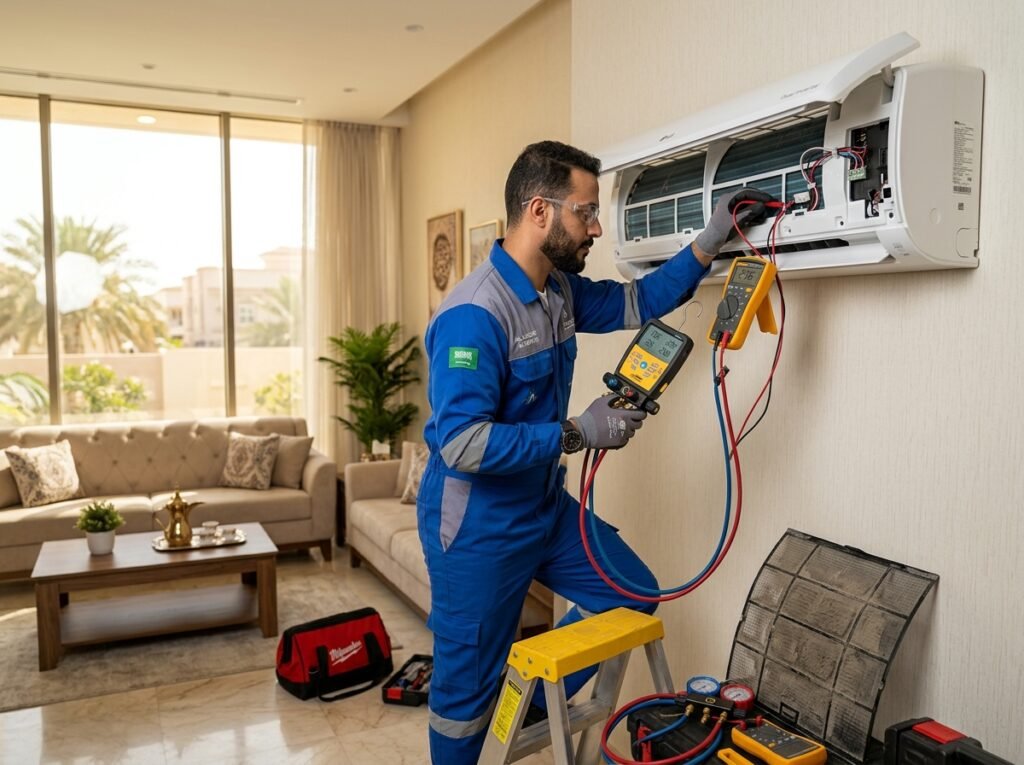
Here’s where field experience matters. Technicians check superheat and subcooling readings to confirm proper refrigerant charge, not just “is there gas in it.” A run capacitor typically carries a rating in microfarads (µF), and one that’s drifted meaningfully outside its labeled value is usually flagged for replacement before it strands a compressor mid-cycle.
Most residential splits in Jeddah run on R-410A refrigerant today, since the older R-22 has been phased out under Saudi and international environmental rules. Amperage draw on the compressor is another key check — a reading noticeably above the nameplate spec often points to a failing start component well before the compressor itself gives out.
Core Benefits and ROI of Fixing AC Problems Early
Fixing a small AC issue the week it appears is almost always cheaper than waiting. A clogged filter or a dirty coil is a low-cost visit. A seized compressor from months of that same neglect is a major repair, sometimes approaching the cost of a full unit swap depending on the system’s age and warranty status.
There’s a comfort return too. A properly serviced AC reaches your target temperature faster and holds it more consistently, which matters a lot when outdoor temperatures are pushing past 40°C and your system has no room for inefficiency.
Financial and Time-Saving Advantages
Beyond the repair bill itself, a neglected AC pulls more electricity to do the same job, which shows up on your monthly bill whether or not you ever notice the airflow difference. Saudi Electricity Company rates make that inefficiency an ongoing cost, not a one-time expense.
Time matters too. A same-day filter clean or capacitor swap takes under an hour in most cases. A full compressor replacement can mean days without cooling in the middle of summer while parts are sourced, especially for less common unit models.
A Specific Metric Worth Knowing
Jeddah’s climate is the metric that matters most here. With daytime highs regularly above 40°C and humidity commonly in the 55–65% range for much of the year, a system fighting a dirty coil or a low refrigerant charge isn’t losing a small amount of efficiency — it’s losing it during the exact months when your AC is under its heaviest possible load. That’s why technicians treat pre-summer maintenance as non-negotiable here, not optional.
Compare that to a milder climate where an AC might idle for half the year. In Jeddah, there’s no real off-season to recover in, which means any inefficiency compounds month after month rather than resetting each winter the way it might elsewhere.
The 10 Most Common AC Problems in Jeddah Homes
These are the issues our technicians encounter most often across Jeddah’s neighborhoods, from inland districts like Al Muhammadiyah to coastal ones like Al Shati. Each one below includes what’s likely causing it, a quick way to check, and whether it’s safe to try yourself.
They’re ordered roughly by how often we see them on service calls, not by severity, so don’t assume problem 10 matters less than problem 1 — a thermostat fault and a refrigerant leak can both leave you without cooling on the hottest day of the year.
1. Weak or No Cold Air
This is the single most common complaint we get. The AC runs, air comes out of the vents, but it isn’t cold — or barely is. In most cases, this points to a low refrigerant charge, usually from a slow leak somewhere in the line set or coil, rather than the refrigerant simply “running out” the way fuel does.
Quick check: Feel the two refrigerant lines running to the outdoor unit. If one is noticeably warmer than it should be, or you spot ice on the indoor coil, that supports a refrigerant issue. Fix it yourself? No. Refrigerant handling requires certified equipment and is not a DIY task — call a licensed technician to find the leak and recharge the system properly.
2. AC Blowing Warm Air On and Off
If cold air comes and goes rather than staying weak constantly, the usual suspect is a dirty or clogged air filter restricting airflow across the evaporator coil. Once airflow drops low enough, the coil can start to ice over, which then blocks airflow even further in a worsening cycle.
Quick check: Pull the filter and hold it up to a light. If you can’t see light through it clearly, it needs replacing. Fix it yourself? Yes — this is one of the easiest and most effective DIY fixes. Replace or wash the filter every 2–4 weeks during Jeddah’s peak season given the dust levels here.
3. Water Leaking From the Indoor Unit
A puddle or drip under your indoor unit almost always means the condensate drain line is clogged, usually with algae, dust, or debris buildup that blocks the water your AC pulls out of the air from draining outside properly.
Quick check: Look for water pooling near the indoor unit or staining on the wall or ceiling below it. Fix it yourself? Partially. You can try clearing visible debris from the drain pan, but flushing the actual drain line safely without damaging the coil is best left to a technician, especially on wall-mounted split units.
4. AC Won’t Turn On At All
When nothing happens at all — no fan, no compressor, no display — the cause is usually electrical: a tripped breaker, a blown fuse, or a failed run/start capacitor that can’t give the compressor the initial power kick it needs to start.
Quick check: Check your electrical panel for a tripped breaker first. If it’s fine, listen for a faint humming from the outdoor unit, which often points to a dead capacitor. Fix it yourself? Resetting a breaker is safe to try. Anything involving the capacitor or internal wiring is not — those components can hold a dangerous electrical charge even when the unit is powered off.
5. AC Short-Cycling (Turning On and Off Repeatedly)
Short-cycling — where the AC starts, runs for a couple of minutes, then shuts off, over and over — usually points to one of three things: a dirty condenser coil overheating the system, a low refrigerant charge tripping a safety switch, or in rarer cases, a unit that was undersized or oversized for the room during installation.
Quick check: Time the cycles. If the AC shuts off within 5 minutes of starting, consistently, that’s short-cycling. Fix it yourself? No. This usually needs a proper diagnostic to identify which of the three causes is at play, and guessing wrong can mean paying for the wrong repair.
6. Strange Noises From the Unit
A rattle usually means a loose panel or debris caught in the outdoor fan. A buzzing sound often points to an electrical issue like a failing contactor. Grinding or squealing is more serious — that’s frequently a fan motor bearing or a compressor under stress.
Quick check: Try to identify roughly where the noise is coming from — indoor unit, outdoor unit, or the ductwork — and describe it as clearly as you can (buzz, click, grind, rattle) when you call for service. Fix it yourself? Only for loose external panels you can safely tighten. Anything involving the fan motor or compressor needs a professional.
7. Bad Smell Coming From the Vents
A musty or mildew-like smell usually means mold or bacteria growth in the drain pan or on the evaporator coil, common in Jeddah’s humidity. A sharp, burning smell is more urgent — that can indicate an electrical component overheating and should be treated as a warning sign, not background noise.
Quick check: Turn the AC off immediately if you smell anything burning or electrical, and don’t turn it back on until it’s been inspected. Fix it yourself? Musty smells can sometimes be resolved with a filter change and drain pan cleaning. Burning smells are never a DIY situation — shut the system down and call a technician the same day.
8. High Electricity Bills Despite Normal Use
If your Saudi Electricity Company bill is climbing but your habits haven’t changed, your AC is likely working harder than it should be — usually from a dirty condenser coil, an aging compressor losing efficiency, or a refrigerant charge that’s drifted off spec over time.
Quick check: Compare this month’s bill to the same month last year rather than to last month, since Jeddah’s seasonal swings make month-to-month comparisons misleading. Fix it yourself? A basic filter and coil clean is DIY-friendly and often the single biggest efficiency fix available. Anything beyond that needs a professional efficiency check.
9. Outdoor Unit Fan Not Spinning
If the compressor hums but the outdoor fan isn’t turning, a failed run capacitor is the most common cause — it’s a cheap part that fails often in Jeddah’s heat. In coastal districts like Al Shati and Obhur Al Shamaliyah, salt-air corrosion on the fan motor or its wiring is also a frequent culprit.
Quick check: Look at the outdoor fan blade directly — if it’s not moving while the unit is clearly powered and humming, that supports a capacitor or motor issue. Fix it yourself? No. This involves live electrical components and should be diagnosed and repaired by a licensed technician.
10. Thermostat Not Responding
Sometimes the AC itself is fine, but the thermostat won’t register your temperature changes or turns the system on and off unpredictably. Causes range from dead batteries in wireless models to a wiring fault, a blown low-voltage fuse, or in smart thermostats, a lost Wi-Fi connection.
Quick check: Swap the batteries first if it’s a battery-powered model — it solves the issue more often than you’d expect. Fix it yourself? Battery swaps and basic resets are safe DIY steps. Wiring faults behind the wall plate should go to a technician to avoid damaging the low-voltage control board.
Choosing the Right AC Repair Professional in Jeddah
Not every technician who advertises AC repair carries the same level of training or accountability. In a city where AC failure is a genuine emergency during summer, the difference between a rushed patch job and a proper diagnostic repair often comes down to who you hire in the first place.
Look past the price quote alone. A technician who takes five extra minutes to explain what’s actually wrong, rather than just naming a part to replace, is usually the one who gets the diagnosis right the first time — which saves you a second, avoidable service call later.
Key Credentials or Features to Look For
Prioritize technicians certified to work on major brands common in Jeddah homes, including LG, Samsung, and Hitachi units. Ask whether they carry genuine manufacturer parts rather than generic substitutes, since off-brand components tend to fail faster in this climate’s heat and humidity.
Same-day availability matters more here than almost anywhere else — a same-day response during a summer heatwave isn’t a luxury, it’s often a necessity. Transparent, upfront pricing before work begins is another strong signal of a trustworthy provider, since it means you know the cost before, not after, the job is done.
Crucial Evaluation Questions to Ask Before Hiring
Before you commit to a technician, a short phone call can save you from a bad experience. These five questions cover the essentials most homeowners forget to ask until it’s too late.
| Question to Ask | Why It Matters |
|---|---|
| Is the diagnostic fee separate from the repair cost? | Prevents surprise charges once the technician arrives and starts work. |
| Do you provide a written quote before starting repairs? | Protects you from price changes mid-job and confirms transparent pricing. |
| Are your technicians certified for my AC’s brand? | Reduces the risk of incorrect diagnosis or improper part replacement. |
| Do you offer a guarantee on completed repairs? | Shows the company stands behind its work if the same issue returns. |
| How quickly can you respond for an emergency call? | Critical in Jeddah’s heat, where a delayed fix means real discomfort. |
Understanding the Investment: AC Repair Costs in Jeddah
AC repair pricing isn’t one-size-fits-all, and any company quoting an exact number before seeing your unit is guessing. What you can control is understanding the cost structure so nothing catches you off guard when the invoice arrives.
Most repairs are priced around three factors: the diagnostic visit, the parts required, and the labor involved in the fix. A filter clean or capacitor swap sits at the low end. A compressor replacement or full refrigerant recharge sits considerably higher, simply because of part cost and labor time involved.
Breakdown of Base Costs
The diagnostic or service call fee covers the technician’s time to inspect the unit and identify the actual problem — this is typically the smallest line item on the invoice. Parts cost varies enormously depending on whether you need a low-cost part like a capacitor or a full compressor, which is a major component with a price to match.
Labor is usually billed based on job complexity rather than a flat hourly rate, since a straightforward filter swap and a full coil replacement involve very different time and skill requirements. Ask for these three items broken out separately on your quote so you can see exactly what you’re paying for.
Hidden Fees or Unexpected Costs
Emergency or after-hours call-outs, particularly during summer heatwaves, often carry a premium over standard daytime rates — ask about this upfront if you’re calling outside normal business hours. Refrigerant cost can also vary depending on how much your system needs and which type it uses, since older R-22 systems can cost more to service than newer R-410A units.
Warranty status matters too. If your AC is still under manufacturer warranty, using a non-authorized technician for certain repairs can void that coverage, turning what looked like a cheaper fix into a much more expensive mistake later.
Pro Tip for Saving Money
Book your annual maintenance visit before summer starts, ideally in March or April, rather than waiting for the first hot week of the year. Technicians are far less booked up during this window, prices tend to be more competitive, and catching small issues before peak season prevents the far more expensive emergency repairs that spike in June and July.
This same logic applies to replacement decisions. If a unit is already showing its age, replacing it in spring — rather than mid-heatwave, when you have no leverage and no time to compare options — almost always works out better for your budget.
Step-by-Step Guide: What to Do When Your AC Breaks Down
Panic makes AC problems worse, not better. Following a clear sequence when your system fails gets you back to cool air faster and helps the technician diagnose the issue accurately on the first visit rather than needing a return trip. It also protects you from making a small problem worse while you wait for help to arrive.
Start with the basics before assuming the worst. A surprising number of “broken AC” calls turn out to be a tripped breaker, a dead thermostat battery, or a filter so clogged it’s mimicking a much bigger failure.
What to Do First
Check your electrical panel for a tripped breaker and reset it once if needed — don’t keep resetting it repeatedly, as that can indicate a deeper electrical fault. Next, check the thermostat display and batteries, then inspect the filter for visible dust buildup.
If none of that resolves it, turn the system off entirely rather than letting it run in a faulty state, and book a technician. Running a struggling AC continuously often turns a minor issue into a major one within hours, especially with compressor-related problems.
Information to Have Ready Before the Technician Arrives
Note your AC’s brand and approximate age, since this speeds up diagnosis considerably. Write down exactly what you observed — when the issue started, any unusual sounds or smells, and whether it’s constant or intermittent.
Have your model number ready if it’s visible on the indoor or outdoor unit nameplate, and know your property’s district and building type, since access to outdoor units in villas versus apartment buildings can affect repair time and approach. A quick photo of the nameplate or the unit itself, sent ahead of the visit, can also help the technician arrive with the right parts on hand.
Expert Strategies for Maximum AC Performance in Jeddah
Set your thermostat to 24–25°C rather than pushing it colder than necessary. Every degree below that forces the compressor to work harder without a proportional comfort benefit, and it adds real strain over a full Jeddah summer.
Keep curtains or blinds closed during peak sun hours, particularly on west-facing windows that catch the harsh afternoon heat. This single habit reduces the cooling load your AC has to fight, which extends component life and lowers your electricity bill simultaneously. Schedule professional coil cleaning at least twice a year here, rather than the once-a-year standard common in milder climates, given how much dust Jeddah’s air carries.
Top Mistakes Jeddah Homeowners Make With Their AC
The most damaging mistakes are usually habits, not one-time errors: ignoring early warning signs, skipping seasonal maintenance, oversizing or undersizing a replacement unit, and continuing to run a system that’s making unusual noises instead of shutting it down.
Each of these turns a small, affordable fix into a major repair simply through repetition and delay. None of them require expert knowledge to avoid — just a willingness to act on the first sign of trouble rather than waiting until the system forces the issue. Below is the single most common and costly one we see.
Mistake 1: Topping Up Refrigerant Without Fixing the Leak
Refrigerant doesn’t get “used up” the way fuel does in a car — a system that’s low on refrigerant has a leak somewhere. Some technicians will top up the charge as a quick fix without locating and sealing that leak, which solves the symptom for a few months while the underlying problem keeps eating away at the system.
How to prevent it: Insist on leak detection as part of any refrigerant service, not just a recharge. Ask directly whether the technician located the leak before adding refrigerant — a reputable provider will confirm this without hesitation, since it’s standard practice for a proper repair.
Maintenance, Longevity, and Long-Term AC Care
An AC that receives consistent care can comfortably outlast one that only gets attention when it breaks — often by several years. In Jeddah’s climate, that gap is even wider, since neglect compounds faster here than in milder regions.
Longevity isn’t about doing more work. It’s about doing the right small things on a consistent schedule rather than reacting only once something fails. Most of what extends a system’s life costs nothing more than a few minutes of attention here and there.
Daily and Weekly Best Practices
Keep the outdoor unit’s surroundings clear of dust buildup, fallen leaves, or stored items that can restrict airflow around the coil. Wipe down visible dust on indoor vents weekly during peak dust season, which is common across Jeddah for stretches of the year.
Listen for changes. A new sound, a longer run time than usual, or a slightly weaker airflow are all worth noting immediately rather than waiting to see if they get worse on their own — these small shifts are usually the cheapest moment to intervene.
Insider Hack for Long-Term AC Success
Keep a simple maintenance log on your phone — just the date and what was done each time a technician visits. Over a year or two, this makes patterns obvious: if the same component keeps failing, that’s a signal worth raising directly with your technician, since it may point to an installation issue rather than normal wear.
It also gives you real leverage in any future conversation about warranty claims or repeat repairs, since you’ll have dates and details on hand instead of a vague memory of “it broke again.”
Comparing Alternative Options: Repair, Recharge, or Replace
When an AC develops a serious fault, homeowners generally face three paths: repair the specific issue, recharge and monitor the system, or replace the unit entirely. The right call depends heavily on the system’s age, the cost of the repair relative to a new unit, and how often problems have recurred.
As a general guideline, a relatively young unit with a single, contained issue is usually worth repairing. A unit nearing the back half of its typical lifespan, with a major component failure and a history of repeat problems, often makes more financial sense to replace.
Traditional Repairs vs Modern Smart AC Solutions
Traditional split systems remain the standard across most Jeddah homes and are generally more affordable to repair, with widely available parts. Modern smart-enabled units offer app-based monitoring and more precise efficiency, which can help catch problems earlier, but they typically cost more upfront and sometimes require specialized parts for repair.
Neither option is universally “better” — it depends on your budget, how long you plan to stay in the property, and whether you value the early-warning data smart systems provide.
Why Professional Repair Usually Wins
For the vast majority of Jeddah homeowners, a proper professional repair of an existing, reasonably aged unit delivers the best value. Replacement makes sense when a unit is old and failing repeatedly, but jumping straight to replacement for a single fixable issue is rarely the most cost-effective choice.
The smarter approach is asking your technician for an honest assessment rather than assuming either extreme. A trustworthy provider will tell you plainly when repair no longer makes financial sense, rather than pushing one option to close a sale.
Geographic, Legal, and Compliance Rules for AC Systems in Jeddah
Air conditioners sold and installed in Saudi Arabia fall under national energy and safety regulations, not just manufacturer guidelines. Knowing the basics helps you make sure any unit you buy or have repaired meets the standards that actually apply here.
This matters most when replacing a full unit, since compliant systems are more energy-efficient by design and tend to hold up better under Jeddah’s demanding conditions. It’s a small thing to check, but it can make a real difference to your running costs over the life of the unit.
Navigating Saudi Energy and Building Regulations
The Saudi Standards, Metrology and Quality Organization (SASO) governs minimum energy performance and labeling requirements for air conditioners sold in the Kingdom under standard SASO 2663, which uses a Seasonal Energy Efficiency Ratio (SEER) rating system. Separately, the Saudi Building Code’s energy conservation requirements (SBC 601 for commercial buildings and SBC 602 for residential) set standards for HVAC system design and installation in new construction.
You can review current energy labeling requirements directly through SASO’s official portal. When replacing a unit, checking for a valid SASO energy label is a simple way to confirm it meets the Kingdom’s current efficiency requirements.
Essential Safety and Risk Mitigation Protocols
Never attempt refrigerant handling yourself — it requires certified equipment and training, and improper handling carries real safety and environmental risks. Always disconnect power at the breaker, not just the remote or wall switch, before any physical inspection of the unit.
For units installed near balconies or shared walls in apartment buildings, confirm that condensate drainage doesn’t create a slip hazard or property damage for neighbors below, which is a common oversight in denser residential districts. It’s a small detail that’s easy to miss during installation but can cause real disputes later.
Conclusion and Summary
Common AC problems in Jeddah homes almost always come down to the same forces: extreme heat, heavy humidity, dust, and in coastal areas, salt-air corrosion. The ten issues covered here account for the large majority of service calls we handle across the city, from Al Basateen to Obhur Al Janoubiyah.
The pattern that matters most is this: small, cheap fixes now prevent large, expensive ones later. A dirty filter left unaddressed for months is exactly how a minor, affordable problem turns into a major, costly one.
Final Recap of What You’ve Learned
You now know the ten most common AC failures in Jeddah, which ones are safe to check or fix yourself, and which ones genuinely need a licensed technician. You also know what drives repair costs, what questions to ask before hiring anyone, and how to keep your system running longer with minimal daily effort. Most importantly, you know that acting early is almost always cheaper than waiting for a full breakdown — the pattern behind nearly every expensive repair we see starts with a warning sign that got ignored.
Next Steps: Book Trusted AC Repair in Jeddah
If any of these symptoms match what you’re experiencing right now, don’t wait for it to get worse in the heat. AC Repair Service In Jeddah covers homes and businesses across Al Basateen, Al Aziziyah, Al Muhammadiyah, Al Murjan, Al Zahraa, Al Naim, Al Nahda, Al Khalidiyah, Al Shati, Obhur Al Shamaliyah, and Obhur Al Janoubiyah.
You can book a certified technician directly through their website or call for same-day service when the issue can’t wait. Whether it’s a quick filter clean or a full compressor diagnosis, getting it looked at now is almost always cheaper and easier than waiting for the next heatwave to force the issue.
Frequently Asked Questions About AC Problems in Jeddah
Top 5 Questions Jeddah Homeowners Ask
1. Why does my AC stop cooling only during the hottest part of the day? This usually means your system is running at or near its maximum capacity already, and any small inefficiency — a dirty filter, a slightly low refrigerant charge — becomes noticeable exactly when the outdoor temperature peaks and the system has no spare capacity left to compensate.
2. How often should I service my AC in Jeddah specifically? Most manufacturers recommend annual servicing, but given Jeddah’s dust and humidity levels, twice-yearly servicing — once before summer and once mid-season — is a more realistic schedule for keeping a system running efficiently through the full cooling season.
3. Is it normal for my outdoor unit to look corroded after a few years? Some surface corrosion is common, especially in coastal districts like Al Shati or Obhur Al Shamaliyah, due to salt in the air. Heavy corrosion affecting the coil fins or wiring isn’t normal, though, and should be inspected before it causes a refrigerant leak or electrical fault.
4. Can I just add refrigerant myself to save money? No. Refrigerant is a regulated substance requiring certified handling equipment, and a system that’s low on refrigerant has a leak that needs to be found and sealed first — simply adding more without fixing the leak just delays the same problem.
5. How do I know if I need a repair or a full replacement? As a general rule, if your unit is still relatively young and this is an isolated issue, repair is usually the better value. If it’s older, has failed repeatedly, or the repair cost approaches a large share of a new unit’s price, replacement is worth seriously considering.
Final Bonus Tip for Every Jeddah Homeowner
Set a recurring reminder on your phone for late March each year to book your pre-summer AC service. This one habit, more than any other single action, is what separates homeowners who sail through Jeddah summers comfortably from those who end up calling for emergency repairs during the first heatwave.
Final Thoughts: Your AC isn’t just an appliance in Jeddah — it’s essential infrastructure for roughly seven months of the year. The ten problems covered here account for the overwhelming majority of breakdowns homeowners face across the city, and most of them are preventable with basic seasonal care. When something does go wrong, act on the early warning signs rather than waiting for a full failure during the hottest week of summer. For fast, transparent, and reliable service anywhere in Jeddah, AC Repair Service In Jeddah is ready to help — reach out through their booking page whenever you need a certified technician on-site.