
AC Making Strange Noises? Here’s What It Means for Your Jeddah Home
A quiet hum in the background is normal. A sudden rattle, screech, or bang is not. If your AC making strange noises has you wondering whether to worry or just turn up the TV, the sound itself is actually your best clue — different noises point to genuinely different problems, and some are urgent while others can wait a few days.
This guide breaks down eight of the most common AC noises we hear about across Jeddah, from villas in Al Basateen to shops in Al Murjan, and tells you exactly what each one usually means. You’ll also get a quick way to check it yourself and an honest verdict on whether it’s safe to investigate further or whether you should shut the system off and call someone today.
Not every noise means disaster — some are completely harmless. But a few are early warnings of a genuine safety risk, and knowing the difference matters more than guessing.
If a sound has you concerned right now, AC Repair Service In Jeddah sends technicians across the whole city, including Al Aziziyah, Al Muhammadiyah, Al Zahraa, Al Naim, Al Nahda, Al Khalidiyah, Al Shati, and both Obhur districts. You can book a diagnostic visit here any time.
What makes noise diagnosis different from most other AC troubleshooting is that you often don’t need to open a single panel to get useful information. The sound itself — where it comes from, when it happens, and how it’s changed — tells a trained technician most of what they need before they even touch the unit.
That’s also exactly why this guide is organized by sound rather than by part. Most homeowners don’t know whether their compressor or their contactor is failing, but everyone can describe what they’re hearing, and that description is the fastest route to the right answer.
Core Introduction to AC Making Strange Noises
Every AC produces some sound — a soft whoosh of airflow, a faint click when it starts or stops, a low hum from the compressor. Those are all normal. The noises worth paying attention to are the ones that are new, getting louder, or clearly mechanical rather than airflow-related.
In our field experience, the noise itself is usually enough to narrow down the cause before we even open the unit. A rattle points somewhere completely different than a squeal, and a technician who’s heard thousands of these calls can often name the likely part before running a single test.
Why This Matters for Jeddah Homeowners and Businesses
Jeddah’s heat means AC units run almost continuously for months at a time, which means components wear faster here than in climates where the system gets real rest. A noise that might take years to develop elsewhere can show up in a single punishing summer here instead.
For property managers overseeing multiple units across districts like Al Nahda and Al Khalidiyah, a noise complaint from one tenant is often worth checking against similar units installed around the same time, since identical systems tend to fail in similar ways. Small business owners face a different stake entirely — a screeching AC in a shop or clinic isn’t just annoying, it’s something customers notice.
A Real-World Scenario: What We See On the Ground
In our field experience, a property manager overseeing several buildings in Al Nahda called about a “grinding” noise a tenant had reported for about a week. The tenant assumed it was normal wear and hadn’t flagged it urgently, since the AC was still cooling fine.
On inspection, the outdoor fan motor bearing was failing, worn down after years of exposure to dust and heat with no lubrication service. Left another few weeks, that motor would have seized completely, turning a straightforward bearing and motor job into a full fan motor replacement. The lesson we repeat constantly: a noise that shows up alongside normal cooling isn’t a reason to wait, it’s a reason to act while the fix is still small.
How AC Noise Diagnosis Actually Works
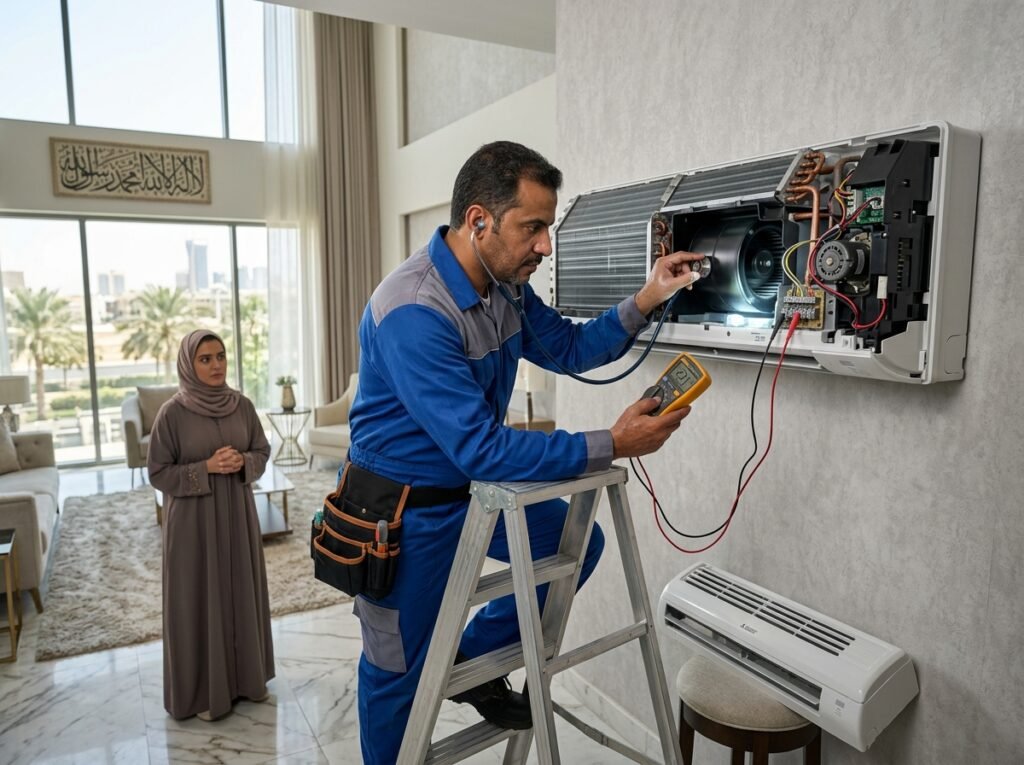
Technicians don’t just listen for a noise — they isolate it. That means running the indoor unit and outdoor unit separately when possible, checking whether the noise happens at startup, during steady operation, or at shutdown, and narrowing down whether the sound is coming from the fan, the compressor, the blower wheel, or the housing itself.
Pitch matters too. High-pitched sounds usually point to something spinning fast, like a fan blade or motor bearing. Low-pitched sounds, like banging or clanking, usually point to something heavier and mechanical, like a compressor component or loose mounting hardware.
The Initial Phase: Isolating Where the Sound Comes From
The first step is always location. Is the noise coming from the indoor unit, the outdoor unit, or somewhere in between, like ductwork? This alone eliminates a huge range of possible causes before any tools come out.
Next comes timing. A noise only at startup often points to a capacitor or relay. A constant noise during operation points more toward a fan, motor, or airflow obstruction. A noise at shutdown can point to a component settling or a loose part shifting as vibration stops.
The Execution Phase: Confirming the Cause
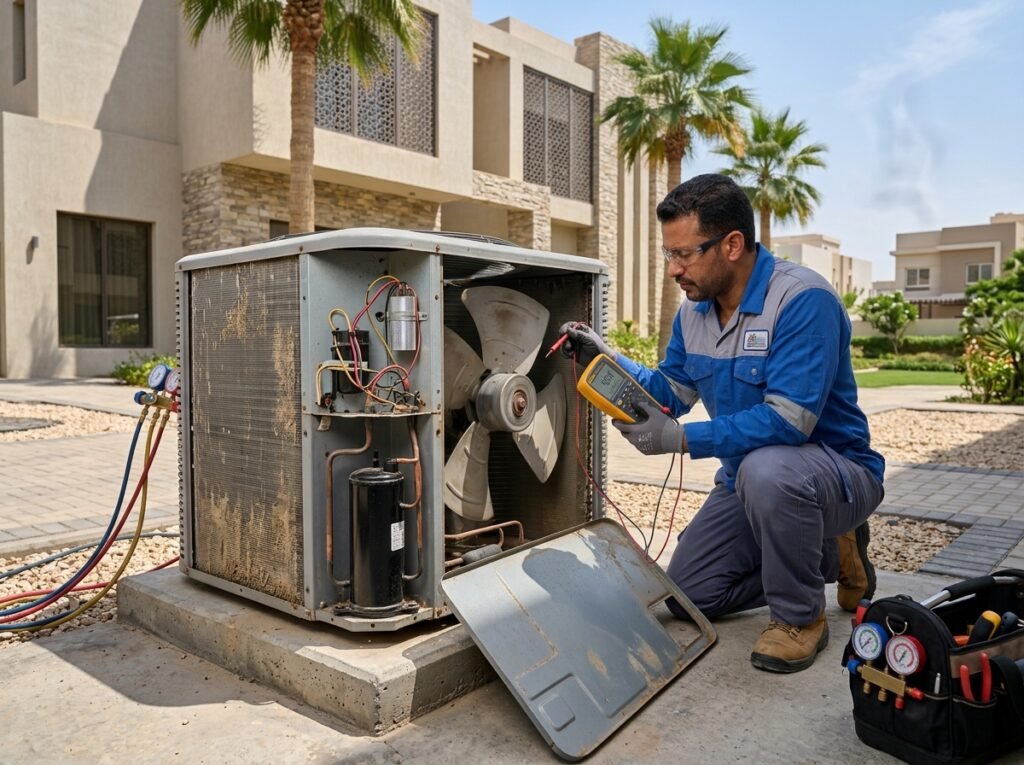
Once the noise is isolated by location and timing, technicians typically remove the relevant panel and inspect visually first — loose screws, debris, worn belts on older units, or visible damage to fan blades are often obvious once you can actually see the component.
If nothing is visually obvious, the next step is measuring. Amperage draw compared against the compressor or motor’s rated Locked Rotor Amps (LRA) can reveal a motor straining to turn, which often produces exactly the kind of grinding or humming sound that started the call in the first place.
Technical Specifications: A Deeper Look
A motor drawing amperage meaningfully above its LRA rating while making noise is a strong signal of mechanical binding, not just a loose part. Technicians also check for excess play in fan blade shafts and bearings, since even a small amount of wobble can produce a surprisingly loud rattle or hum once the fan spins at full speed.
For compressors specifically, a knocking or clanking sound during startup can indicate loose internal components, which is a more serious finding than an external fan or motor issue and often points toward a compressor nearing the end of its service life rather than a simple repair.
Core Benefits and ROI of Catching Noises Early
A noise caught in its first week is almost always a small, contained fix — a loose screw, a worn bearing, a bit of debris. The same noise left for a month can mean a seized motor, a damaged fan blade, or in worse cases, real compressor damage that turns a repair into a much larger job.
There’s a comfort factor too. A noisy AC is a distracting AC, whether you’re trying to sleep, work, or run a business. Fixing the sound issue often improves the day-to-day experience of using your space just as much as it protects the equipment itself.
Financial and Time-Saving Advantages
Most noise-related repairs, when caught early, are quick, low-cost visits: a screw tightened, a bearing lubricated or replaced, debris cleared from a fan. These are typically same-day fixes that take well under an hour once a technician is on-site.
Wait too long, and the same fault can damage the component it’s attached to — a bearing that seizes can take the motor with it, and a compressor that’s been knocking for weeks can fail entirely. The math is simple: early noise repairs cost a fraction of what late-stage component failures do.
A Specific Metric Worth Knowing
Indoor AC units typically operate around 20 to 30 decibels on normal settings, while outdoor condenser units generally run somewhere between 45 and 60 decibels depending on the model and fan speed. Those numbers matter because a noticeable jump above your unit’s normal baseline — not just a new type of sound, but a meaningfully louder one — is a reliable signal that something has changed mechanically.
If you’re unsure whether a sound is “loud,” compare it to normal conversation, which sits around 60 decibels. An outdoor unit that’s suddenly as loud as two people talking a few feet away is well outside its expected range.
Common Types of AC Noises and What They Mean
Here are the eight sounds we get asked about most often across Jeddah, along with what each one usually points to and whether it’s safe to check yourself.
A note on how to use this section: read through all eight before assuming yours is the first match you find. Some noises share overlapping symptoms, and the timing of the sound — startup, steady running, or shutdown — is often what actually separates one likely cause from another, more than the sound alone.
1. Rattling
Rattling is almost always mechanical and almost always the least urgent noise on this list. Loose screws on an access panel, a stray twig or debris caught in the outdoor fan, or a loose fan blade are the most common causes.
Quick check: Look for anything visibly loose or lodged in the outdoor unit’s fan guard. Fix it yourself? Often yes — tightening visible screws or removing debris (with the power off) is safe DIY territory. If the rattle continues after that, a loose internal part needs a technician.
2. Buzzing
A buzzing sound is usually electrical. Loose wiring, a failing contactor, or a capacitor starting to go can all produce a buzz, sometimes alongside the outdoor fan struggling to spin at full speed. It can also show up if a fan blade is slightly out of balance and brushing against something as it turns.
Quick check: If the outdoor fan is spinning slowly or not at all while you hear buzzing, that supports an electrical cause. Fix it yourself? No. Anything involving contactors, capacitors, or wiring carries real electrical risk and needs a licensed technician.
3. Repeated Clicking Without Starting
An occasional single click at startup or shutdown is completely normal — that’s usually a relay engaging. Repeated clicking that doesn’t lead to the system actually starting is a different story, and usually points to a failing capacitor or relay stuck in a loop, sometimes called “hard starting” by technicians.
Quick check: Count the clicks. One click per cycle is normal. Rapid, repeated clicking with no compressor start is not. Fix it yourself? No. This is a same-day electrical diagnostic job, not a DIY fix.
4. Banging or Clanking
This is one of the more serious sounds on this list. It often points to a loose or broken part inside the compressor itself, disconnected mounting hardware causing the unit to shift during operation, or in some cases, a damaged indoor blower wheel.
Quick check: Note whether the banging happens at startup, during operation, or at shutdown, since this timing helps narrow the cause considerably. Fix it yourself? No. Turn the system off and call a technician — running a unit with a banging compressor risks turning a repairable issue into a full replacement.
5. Hissing
A brief hiss at the start or end of a cooling cycle is often just normal refrigerant movement through the expansion valve. A continuous hiss, especially alongside weaker cooling, is a different matter and often points to a refrigerant leak somewhere in the line set or coil.
Quick check: Time it. A hiss lasting a few seconds at cycle start or stop is likely normal. A constant hiss is not. Fix it yourself? No. Refrigerant leaks require certified detection equipment and handling, full stop.
6. Squealing or Screeching
This high-pitched sound usually points to a fan motor bearing wearing out, or on older units with belt-driven components, a belt that’s slipping or worn. It’s uncomfortable to listen to and tends to get louder over time rather than resolving on its own, especially once the bearing starts running dry.
Quick check: The sound typically comes specifically from the outdoor fan motor area. Fix it yourself? No. Bearing replacement and belt adjustment both require the unit to be safely disassembled, which isn’t a homeowner task.
7. Grinding
Grinding is one of the more urgent sounds here. It usually means a motor bearing has worn down significantly, debris is caught directly in a spinning fan blade, or in more serious cases, internal compressor damage that’s already underway.
Quick check: A grinding sound from the outdoor unit that’s noticeably worse than a squeal suggests advanced wear rather than an early-stage issue. Fix it yourself? No. This needs same-day attention, since continued operation risks turning a motor repair into a full replacement.
8. Loud Humming Without the System Starting
If the AC hums but nothing actually starts — no fan movement, no cooling — a failed capacitor is the most likely cause. In more serious cases, this can indicate a seized motor or a compressor that’s struggling to start against internal resistance and drawing far more current than it should.
Quick check: Confirm the outdoor fan isn’t moving at all while the humming continues. Fix it yourself? No. This is a common capacitor fault, but diagnosing and replacing it safely requires a licensed technician.
Choosing the Right AC Noise Diagnostic Professional in Jeddah
Not every technician is equally good at noise diagnosis specifically. Some will replace the first part that seems plausible rather than actually isolating the sound first, which can mean paying for a repair that doesn’t fix the actual problem.
Ask how they approach a noise complaint before booking. A technician who talks about isolating the sound by location and timing, rather than jumping straight to a part replacement, is the one more likely to get it right on the first visit.
Key Credentials or Features to Look For
Look for technicians certified across the brands common in Jeddah homes and businesses, including LG, Samsung, and Hitachi, since noise-related components can vary meaningfully between manufacturers. Confirm they carry genuine replacement parts, since generic bearings and fan blades tend to fail faster and can introduce new noises of their own.
Same-day availability matters here too, particularly for the more urgent sounds on this list like banging or grinding. A provider that separates the diagnostic visit from the repair cost, with clear pricing at each stage, is generally more trustworthy than one that quotes a flat fee before even hearing the noise.
Crucial Evaluation Questions to Ask Before Hiring
A short phone call before booking can save you from paying for the wrong repair. These five questions cover what most homeowners forget to ask.
| Question to Ask | Why It Matters |
|---|---|
| How do you isolate where a noise is coming from? | Confirms a real diagnostic process rather than a guess. |
| Is the diagnostic fee separate from the repair cost? | Prevents paying for a visit that doesn’t fix the issue. |
| Do you explain what part failed and why? | Protects you from vague explanations that don’t hold up. |
| Are your technicians certified for my AC’s brand? | Reduces the risk of the wrong part being installed. |
| What happens if the noise returns after the repair? | Shows whether the company stands behind its diagnosis. |
AC Making Strange Noises? Here’s What Repairs Cost
Pricing for a noise-related repair depends heavily on which of the eight causes above turns out to be correct, which is exactly why a proper diagnosis needs to come before any firm quote. What you can rely on is the general cost structure behind almost every invoice.
Most noise repairs break down into a diagnostic visit, the part required once the cause is confirmed, and labor. A loose screw or minor debris clearing sits at the very low end. A compressor-related noise sits considerably higher, given the complexity and risk involved in that kind of repair.
Breakdown of Base Costs
The diagnostic visit covers the technician’s time to actually isolate and confirm the noise source — this is usually the smallest line item, even though it’s the most important step in getting the right fix. Part costs vary enormously between something small like a capacitor and something major like a compressor.
Labor is generally billed by job complexity, since tightening a panel and replacing a fan motor bearing involve very different time and skill requirements. Always ask for these components listed separately so you know exactly what you’re being charged for.
Hidden Fees or Unexpected Costs
Emergency same-day visits for urgent noises like grinding or banging can carry a premium over standard scheduling, so confirm this upfront if you’re calling outside normal hours. If the noise turns out to be compressor-related, expect the estimate to be notably higher than a fan or capacitor fix, given the complexity of that repair.
Warranty status is worth checking before any repair too, since using a non-authorized technician on certain components can void manufacturer coverage that would otherwise have covered the fix.
Pro Tip for Saving Money
Don’t wait for a noise to become unbearable before calling. The sounds on this list are cheapest to fix in their first week or two, before wear compounds and before a small issue damages the part it’s attached to. A rattle ignored for a month can become a fan blade replacement instead of a five-minute screw tightening.
This is especially true for bearing-related sounds like squealing and grinding, which almost always get progressively worse rather than resolving on their own.
AC Making Strange Noises? Your Step-by-Step Diagnostic Guide
Working through a clear process before calling helps you describe the issue accurately and can occasionally resolve it entirely without a service visit. It also protects the system from further damage if the sound turns out to be something serious, rather than letting it run unchecked.
Start by identifying the basics: which unit is making the noise, when it happens during the cooling cycle, and whether it’s gotten louder or more frequent since you first noticed it.
What to Do First
If the sound is banging, grinding, or accompanied by any burning smell, turn the system off immediately rather than continuing to troubleshoot. For less urgent sounds like rattling or occasional clicking, a quick visual check of the outdoor unit for loose panels or debris is a safe first step to take on your own.
Note exactly when the noise occurs — startup, steady running, or shutdown — since this detail alone often narrows down the likely cause before a technician even arrives.
Tools and Information to Have Ready
A basic flashlight helps you inspect the outdoor unit for visible debris or loose panels before the visit. If possible, record a short video or audio clip of the noise, since this can help a technician recognize the likely cause even before seeing the unit in person.
Have your AC’s brand, approximate age, and installation date ready if known, since older units are statistically more likely to have worn mechanical components like bearings and fan motors. A quick note on how long the sound has been happening also helps.
Expert Strategies for Maximum Cooling Performance
Keep the outdoor unit’s surroundings clear of leaves, dust, and loose debris that can work their way into the fan and cause exactly the kind of rattling and grinding covered in this guide. A five-minute visual check every couple of weeks during dusty stretches catches most of these before they start.
Schedule a professional inspection twice a year rather than waiting for a noise to appear, since a trained ear during routine maintenance often catches early bearing wear or loose components before they become audible to an untrained one. This single habit prevents a large share of the urgent, same-day noise calls we handle across Jeddah.
Top Mistakes Jeddah Homeowners Make With AC Noises
The most common mistake by far is assuming that if the AC is still cooling, the noise can wait. Cooling performance and mechanical health are two separate things, and a system can keep cooling perfectly while a component quietly wears toward failure.
Other common mistakes include running a clearly serious noise like banging or grinding continuously instead of shutting the system off, and assuming a noise will simply “wear itself in” rather than getting worse. Below is the single most damaging version of this pattern.
Mistake 1: Ignoring a New Noise Because the AC Still Cools Fine
This is the mistake behind nearly every “surprise” motor or compressor failure we see. The AC sounds different, sometimes for weeks, but since the air coming out is still cold, it gets mentally filed under “not urgent.”
How to prevent it: Treat any new, unexplained noise as worth a same-week check, regardless of whether cooling performance has changed. The whole value of catching a noise early is that it happens before cooling is affected — waiting for cooling to suffer means you’ve already missed the cheap window to fix it.
Maintenance, Longevity, and Long-Term Cooling Reliability
Most of the noises covered in this guide are preventable with basic, consistent care. Bearings that get lubricated on schedule rarely grind. Fans kept clear of debris rarely rattle. The pattern holds across nearly every cause on this list.
In Jeddah specifically, dust accumulates faster than in most climates, which means the maintenance schedule that works fine elsewhere often isn’t frequent enough here. A little extra attention during the dustiest months goes a long way toward keeping these sounds from ever starting.
Daily and Weekly Best Practices
Do a quick visual check of the outdoor unit every week or two during dusty periods, looking for debris buildup around the fan and any visibly loose panels or hardware. This takes under a minute and catches a meaningful share of rattling causes before they start.
Pay attention to your system’s normal sound profile so you actually notice when something changes. Most homeowners who catch problems early aren’t experts — they just know what “normal” sounds like for their specific unit.
Insider Hack for Long-Term Cooling Success
Record a short 10-second audio clip of your AC running normally once a season, saved somewhere easy to find on your phone. If a new noise ever shows up, you’ll have an actual baseline to compare it against instead of relying on memory, which makes describing the change to a technician far more precise.
This same recording is genuinely useful for technicians too — a before-and-after comparison often speeds up diagnosis considerably, especially over the phone before anyone’s even arrived.
Comparing Alternative Options: Guesswork vs Professional Diagnosis
When a new noise shows up, homeowners generally take one of two paths: try to identify and fix it themselves through trial and error, or bring in a technician who isolates the sound systematically using timing, location, and measurement.
Both paths can work, but they carry very different risks. Guesswork can accidentally fix a simple rattle, but it can also mean tightening the wrong screw while a real electrical or mechanical fault keeps developing underneath, unnoticed until it’s much more serious.
Traditional Guesswork vs Systematic Diagnosis
Trial-and-error troubleshooting works reasonably well for the simplest, most obvious causes on this list, like a visibly loose panel or debris you can see and remove yourself. It tends to fail once the cause is electrical or hidden inside a sealed component.
Systematic diagnosis — isolating by location, timing, and amperage measurement — costs more upfront in the form of a diagnostic fee, but it consistently identifies the actual cause rather than the most convenient guess, which avoids paying for repairs that don’t actually fix anything.
Why Professional Diagnosis Usually Wins
For anything beyond a simple, visible cause, professional diagnosis wins because it’s actually testing the system rather than guessing based on the most common explanation. That distinction matters most for the more serious sounds on this list, like banging, grinding, and buzzing, where a wrong guess can mean real safety risk or wasted money on the wrong part.
The best approach combines both: try the safe, visible checks yourself first, and bring in a professional the moment the cause isn’t obvious or the sound falls into one of the more urgent categories covered earlier.
Geographic, Legal, and Compliance Rules for AC Systems in Jeddah
AC units installed in Saudi Arabia fall under national energy performance and building regulations, which becomes especially relevant if a noise diagnosis points toward replacing a component or the whole unit rather than a simple repair. Even a repair sometimes brings this into play, if the replacement part itself needs to meet current efficiency standards.
Confirming any replacement parts or units meet current standards protects both your investment and your long-term running costs over the life of the system.
Navigating Saudi Energy and Building Regulations
The Saudi Standards, Metrology and Quality Organization (SASO) sets minimum energy performance and labeling requirements for AC units under standard SASO 2663, while the Saudi Building Code’s energy conservation requirements (SBC 601 for commercial buildings, SBC 602 for residential) govern HVAC design standards more broadly. Neither standard regulates noise directly, but compliant, well-manufactured units generally run quieter than older or non-compliant equipment, since better-engineered components produce less mechanical vibration.
You can review current requirements directly through SASO’s official portal if a noise diagnosis leads toward a replacement decision.
Essential Safety and Risk Mitigation Protocols
Never continue running a unit that’s banging, grinding, or buzzing alongside a burning smell — shut it off at the breaker, not just the remote, and call a technician the same day. These specific combinations carry real fire and electrical risk, not just equipment damage.
For units in shared spaces or near neighboring properties, keep in mind that unusual noise can also signal loose mounting that risks the unit shifting or falling, which is a safety issue worth flagging immediately in denser residential districts.
Conclusion and Summary
An AC making strange noises is telling you something specific, not just being generally annoying. The eight sounds covered here account for the large majority of noise complaints we handle across Jeddah, and each one points toward a distinct, identifiable cause rather than a vague sense that “something’s wrong.”
The pattern that matters most: noise almost always arrives before cooling performance suffers, which means it’s also the cheapest possible moment to get it fixed, whichever of the eight causes turns out to be behind it.
Final Recap of What You’ve Learned
You now know what each of the eight most common AC noises usually means, which ones are safe to check yourself, and which ones need same-day professional attention. You also understand how noise-related repairs are typically priced and what questions separate a real diagnosis from a guess before you hire anyone.
Most importantly, you know that a new noise alongside normal cooling isn’t a reason to wait — it’s the earliest and cheapest opportunity to fix whatever’s actually wrong before it gets worse.
Next Steps: Get Your AC Noise Diagnosed in Jeddah
If your AC is making a sound that wasn’t there before, don’t wait to see if it goes away on its own. AC Repair Service In Jeddah covers the full city, including Al Khalidiyah and Al Murjan.
You can book a diagnostic visit directly through their website and get a clear answer on what’s actually causing the sound, rather than a guess. Whether it turns out to be a five-minute fix or something bigger, knowing the real cause is what protects both your comfort and your budget.
Frequently Asked Questions
Top 5 Questions Jeddah Homeowners Ask
1. Is it normal for my AC to make any noise at all? Yes — a soft airflow whoosh, a faint compressor hum, and a single click at startup or shutdown are all normal. An AC making strange noises beyond that — anything new, anything getting louder, or anything clearly mechanical like grinding or banging — is what’s worth investigating.
2. My AC is making a buzzing noise but still cooling fine — can it wait? Cooling performance and the cause of a buzzing noise are separate issues. Buzzing usually points to an electrical fault, which can worsen even while cooling still works, so it’s worth a same-week check rather than waiting for cooling to be affected too.
3. What’s the most urgent AC noise I should never ignore? Banging, grinding, or any noise paired with a burning smell should be treated as urgent. Turn the system off and call a technician the same day, since these combinations can point to real mechanical or electrical safety risks, not just equipment wear.
4. Can I fix a rattling AC noise myself? Often, yes. Rattling is frequently caused by loose panel screws or debris caught in the outdoor fan, both of which are safe to check and fix yourself with the power off. If the rattle continues afterward, the cause is likely internal and needs a technician.
5. Will a noisy AC use more electricity? It can, depending on the cause. A struggling motor or a fan working against debris or a bearing issue often draws more power to do the same job, so fixing the noise can improve both comfort and your Saudi Electricity Company bill.
Final Bonus Tip for Every Jeddah Homeowner
The next time your AC sounds even slightly different than usual, trust that instinct. You know your unit’s normal sound better than anyone, and acting on a small change is almost always cheaper and easier than waiting for it to become impossible to ignore.
Final Thoughts: An AC making strange noises isn’t something to just live with — each sound is a specific signal pointing toward a specific, fixable cause, and catching it early is consistently the cheapest path forward. Trust a new or unusual sound over the assumption that “it’s still cooling, so it’s fine.” For fast, properly diagnosed AC noise repairs anywhere in Jeddah, AC Repair Service In Jeddah is ready to help — reach out through their booking page the moment something sounds off.