
Understanding AC Error Codes: What They Mean in Jeddah
Mastering Understanding AC Error Codes: What They Mean saves homeowners and commercial facility managers from sweltering summer nights when a split or central cooling unit suddenly halts. You walk into your living room on a forty-five-degree afternoon expecting crisp, icy relief. Instead, the indoor louver shuts itself, the compressor goes silent, and a cryptic two-digit alphanumeric code flashes relentlessly on the front LED display. Across coastal districts like Al Shati, Al Basateen, and Obhur Al Shamaliyah, heavy Red Sea humidity and blowing desert silica push residential air conditioners to their absolute operating limits. Blinking fault symbols are not random electrical glitches.
In our field experience repairing thousands of inverter and fixed-speed systems across the city, every alphanumeric flash represents a specific self-diagnostic warning from the main Printed Circuit Board (PCB). Modern air conditioners from Gree, LG, Samsung, Daikin, Midea, and Carrier continuously monitor pipe temperatures, refrigerant pressures, fan motor speeds, and direct current voltages. When any parameter crosses a safe factory limit, the microprocessor triggers a protective lockout to stop the compressor from burning out. Understanding AC Error Codes allows you to distinguish between a simple five-minute filter reset and a dangerous high-voltage short circuit or refrigerant leak that demands professional tools.
Guessing at fault codes or repeatedly flipping the wall breaker often turns a cheap thermistor replacement into a ruined motherboard. Whether you manage an office in Al Zahraa or own a family villa in Al Muhammadiyah, knowing how to read your unit’s display protects your budget and restores indoor comfort fast. If your air conditioner is flashing an unfamiliar warning right now, booking a diagnostic visit through AC Repair Service In Jeddah connects you with certified technicians carrying digital manifold gauges, OEM sensors, and advanced PCB testers. You can also explore our 24/7 emergency AC repair services in Jeddah to stop mid-summer breakdowns before extreme heat damages your property.
Core Introduction to Understanding AC Error Codes
Modern air conditioning systems rely on onboard microcontrollers rather than simple mechanical thermostats. Inside every wall-mounted split, ceiling cassette, and ducted package unit sits a network of Negative Temperature Coefficient (NTC) thermistors, Hall-effect fan sensors, and current transformers. Understanding AC Error Codes: What They Mean starts with knowing how these sensors talk to the main control board. Letter prefixes like E, F, H, P, or CH usually indicate which subsystem failed—such as electrical communication, temperature sensing, or inverter drive protection—while the following numbers pinpoint the exact faulty component so technicians can fix the problem without guesswork.
Why Understanding AC Error Codes Matters for the Local Area
For residents and business owners in Al Aziziyah, Al Murjan, and Al Khalidiyah, an air conditioner shutdown during peak summer quickly becomes an urgent household emergency. Coastal humidity routinely climbs past eighty percent while afternoon shade temperatures stay above forty-four degrees Celsius. When a unit locks out with an E4 or H6 error, concrete villa walls radiate trapped heat indoors within two hours. Understanding AC Error Codes helps property owners stop minor drainage or airflow issues immediately, preventing water overflow across decorative gypsum ceilings and avoiding multi-day waits for spare parts during peak summer demand.
A Real-World Scenario or Example
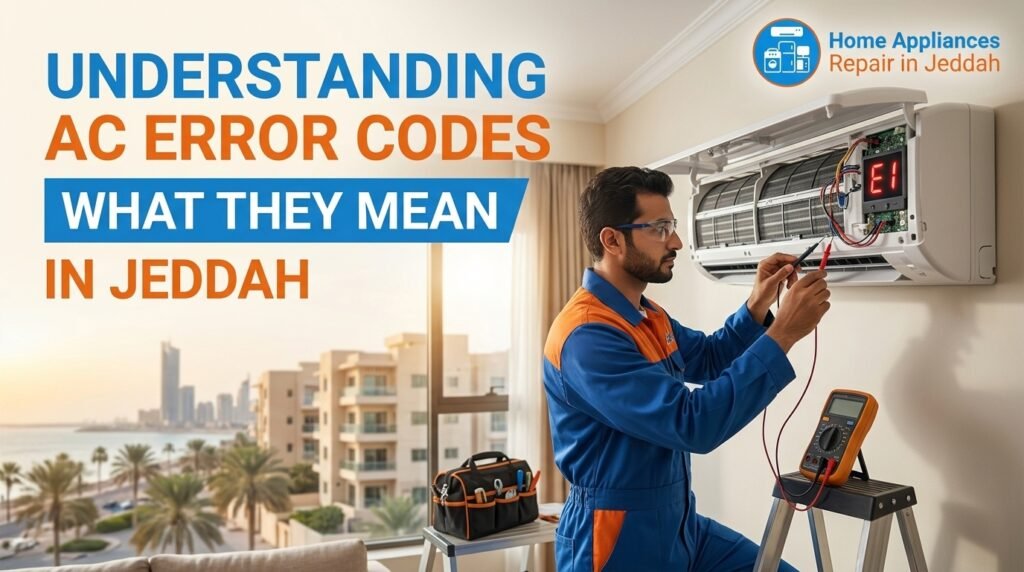
In our field experience responding to an urgent call in Obhur Al Janoubiyah, a homeowner reported their two-ton split unit flashing code E1 and refusing to start the outdoor compressor. A street handyman had told them the main outdoor computer board was dead and demanded two thousand riyals. What we typically see on the ground is far less dramatic. Using a digital multimeter, we applied our checklist for Understanding AC Error Codes and tested the four-core signal cable linking the indoor and outdoor terminals. Coastal salt mist had corroded the signal lug. Cleaning and re-crimping the wire fixed the unit in twenty minutes.
How Understanding AC Error Codes Actually Works / The Core Process
Every time you press the power button on your remote control, your air conditioner runs a three-second pre-flight safety check before energizing the compressor. The indoor PCB measures resistance across the room air thermistor and evaporator coil sensor, verifies zero-cross AC voltage, and sends a low-voltage serial pulse to the outdoor unit. Understanding AC Error Codes means following this exact electronic sequence. If a sensor reports an open circuit, a shorted wire, or a temperature outside safe limits, the microcontroller aborts startup and illuminates a specific alphanumeric code or LED blink sequence on the front panel.
The Initial Phase / Preparation
Before opening any air conditioner cabinet, proper diagnostic preparation keeps both the technician and the appliance safe. First, write down the exact alphanumeric code or count the number of LED blinks and pauses on the indoor display before touching the circuit breaker. Turning off the power too early wipes transient fault codes stored in volatile memory. Once you record the code, switch off the dedicated double-pole breaker at the wall disconnect and wait five full minutes. This waiting period lets high-voltage electrolytic capacitors on the inverter board discharge completely before anyone removes the plastic housing or electrical terminal cover.
The Execution / Implementation Phase
During active troubleshooting, technicians match the recorded fault code against the manufacturer’s service schematic pasted inside the control lid. For sensor errors like F1 or F2, we unplug the thermistor harness from the PCB and measure resistance in kilo-ohms using a calibrated multimeter. For refrigerant warnings like EC or CH38, we connect digital manifold gauges to the brass service valve, pressurize the copper lines with dry nitrogen to locate leaks, braze the faulty joint, pull a vacuum below 500 microns, and weigh in pure R410A or R32 gas. Finally, we clear the fault log and run a full load test.
Technical Specifications in Understanding AC Error Codes
Accurate board-level diagnostics require exact electrical benchmarks. Most residential AC room and pipe thermistors operate at either 5 kilo-ohms, 10 kilo-ohms, or 15 kilo-ohms at a baseline temperature of 25 degrees Celsius. As copper coil temperatures rise, NTC sensor resistance drops predictably along a logarithmic curve. Meanwhile, compressor discharge pipe thermistors typically measure 50 to 200 kilo-ohms at 25 degrees Celsius. Understanding AC Error Codes also involves checking DC link voltage across the outdoor Intelligent Power Module (IPM), which must remain stable between 310V and 380V DC. Consulting ASHRAE technical HVAC standards and guidelines ensures accurate thermodynamic and electrical verification.
Core Benefits and ROI of Understanding AC Error Codes
Taking a few minutes for Understanding AC Error Codes: What They Mean delivers immediate financial protection for homeowners and commercial property managers. Instead of paying dishonest contractors for phantom compressor replacements, you know right away whether your screen indicates a clogged air filter, a faulty fifteen-riyal temperature sensor, or a loose communication wire. Early code recognition also protects the most expensive part of your air conditioner—the variable-speed rotary compressor—from running under overheated or low-oil conditions. Catching warning codes early extends equipment life past twelve years even in harsh Red Sea coastal weather.
Financial, Strategic, or Time-Saving Advantages
Deciphering fault codes before calling dispatch cuts both repair time and monthly utility bills. When you tell your technician the exact brand model and error code over the phone—such as a Gree H6 fan motor error or a Samsung E121 room sensor fault—the service van arrives stocked with the exact replacement component. That eliminates frustrating second trips and gets your bedroom or retail shop cool within an hour. Furthermore, clearing hidden coil sensor faults stops your inverter compressor from running stuck at maximum wattage all afternoon, cutting summer electricity bills across neighborhoods like Al Nahda and Al Naim.
Specific Data Point or Metric to Consider
Field diagnostics show that ignoring early thermal or refrigerant warning codes—such as E4 high discharge temperature or EC refrigerant leak alerts—for just seventy-two hours increases total repair costs by over 400 percent. Operating a rotary compressor when suction superheat exceeds 25 degrees Fahrenheit breaks down synthetic polyolester (POE) lubricating oil and scores internal cylinder walls. Furthermore, maintaining factory sensor accuracy keeps equipment compliant with SASO minimum energy performance standards, preserving an indoor supply-to-return temperature split (Delta-T) between 18 and 22 degrees Fahrenheit while reducing compressor amperage draw by up to 24 percent.
Common Industry Challenges & Roadblocks
Diagnosing air conditioner fault codes in coastal Saudi Arabia involves three stubborn regional challenges. First, different manufacturers use identical codes for completely different failures; for example, E1 means a communication error on Midea and Gree units, but signals a room thermistor fault on several older split models. Second, salty coastal air in Al Shati and Obhur corrodes outdoor PCB pins, causing false intermittent sensor codes that vanish when the unit cools down. Third, frequent summer power grid sags trigger P-series voltage protection lockouts. Understanding AC Error Codes requires cross-referencing brand-specific service charts rather than relying on generic internet guesses.
Choosing the Right Solution / Professional
Modern inverter air conditioners contain sensitive dual-layer circuit boards that carry lethal direct current voltages. Hiring an untrained neighborhood handyman who twists wires together or bypasses safety sensors to clear an error code will destroy your compressor and create a serious electrical fire hazard. When you book service through AC Repair Service In Jeddah, you get certified HVAC technicians who specialize in Understanding AC Error Codes across all major brands including LG, Gree, Carrier, Samsung, Daikin, and Zamil. Our mobile teams carry original manufacturer sensors, digital multimeters, and board-level repair tools to fix the real fault safely.
Key Credentials or Features to Look For
Always verify that your chosen HVAC repair company employs technicians trained in electronic inverter diagnostics and closed-loop refrigeration recovery. A qualified specialist should carry a true-RMS digital multimeter, an electronic micron vacuum gauge, and brand-specific thermistor resistance charts. Ask whether the company repairs outdoor PCBs at the component level or forces you to buy expensive whole-board assemblies for minor fuse or varistor faults. Reputable contractors also provide transparent flat-rate diagnostic pricing, explain what the displayed error code means in plain language, and issue a written warranty covering both replacement electronics and labor.
Crucial Evaluation Questions
Before letting any technician work on your air conditioner, ask these five questions based on Understanding AC Error Codes:
| Question to Ask | Why It Matters |
| What does this specific error code mean for my AC brand? | Confirms the technician knows brand-specific fault tables. |
| Will you test sensor resistance in ohms before swapping boards? | Stops unnecessary PCB replacements when a cheap sensor failed. |
| Do you check outdoor terminal blocks for coastal salt corrosion? | Fixes the root cause of E1 and CH05 communication lockouts. |
| Will you weigh refrigerant on a digital scale after fixing EC leaks? | Inverter compressors require exact gram charges to clear codes. |
| Do you provide a written warranty on PCB and sensor repairs? | Protects your wallet if the same error code returns next week. |
Understanding the Investment / Pricing Structure
The cost of resolving an air conditioner error code in Jeddah depends entirely on which subsystem triggered the alarm. Airflow and drainage codes caused by dirty evaporator coils, clogged condensate float switches, or loose wiring terminals are inexpensive and fast to clear. Sensor faults involving indoor room thermistors, copper pipe sensors, or capacitor swaps fall into a moderate, budget-friendly price bracket. Major error codes pointing to shorted outdoor Intelligent Power Modules (IPMs), seized Brushless DC (BLDC) fan motors, or refrigerant leaks requiring copper brazing and R32 recharging involve specialized parts and higher technical labor.
Breakdown of Base Costs or Resources Required
Professional error code repair is divided into three clear cost categories: electronic diagnostics, replacement components, and mechanical labor. A standard diagnostic call covers decoding the fault memory, testing thermistor kilo-ohm values, verifying line and DC bus voltages, and checking refrigerant pressures. Minor sensor or capacitor replacements take under forty-five minutes on-site. Medium repairs involve clearing blocked condensate pumps, repairing corroded communication wiring, or soldering blown PCB varistors. You can view our affordable AC diagnostic and repair packages in Jeddah to get upfront, honest pricing before any repair work begins on your cooling unit.
Hidden Fees or Unexpected Resource Drains
Unexpected repair expenses almost always happen when homeowners ignore blinking warning codes or hire unverified street laborers. If your display flashes an EC or F0 low-refrigerant code and you keep forcing the unit to run, the uncooled compressor motor windings overheat and burn out, turning a minor leak repair into a major compressor replacement. Untrained handymen also create costly damage by splicing mismatched generic thermistors into the circuit board, which feeds wrong temperature data to the microprocessor and freezes the indoor evaporator solid. Fixing the genuine cause on day one prevents cascading part failures.
Pro Tip for Saving Money / Maximizing Efficiency
In our field experience across villas in Al Zahraa and Al Khalidiyah, nearly half of all E-series and P-series outdoor PCB error codes are caused by dirty condenser coils or minor power surges rather than dead circuit boards. Before paying hundreds of riyals for a new inverter motherboard when your unit flashes an IPM or high-current code, have your technician wash the outdoor condenser fins thoroughly and test the board’s fifty-riyal bridge rectifier and thermistor plugs. Often, dropping head pressure through a deep chemical coil wash eliminates thermal overload codes immediately without buying expensive electronic assemblies.
Step-by-Step Implementation Guide: Understanding AC Error Codes
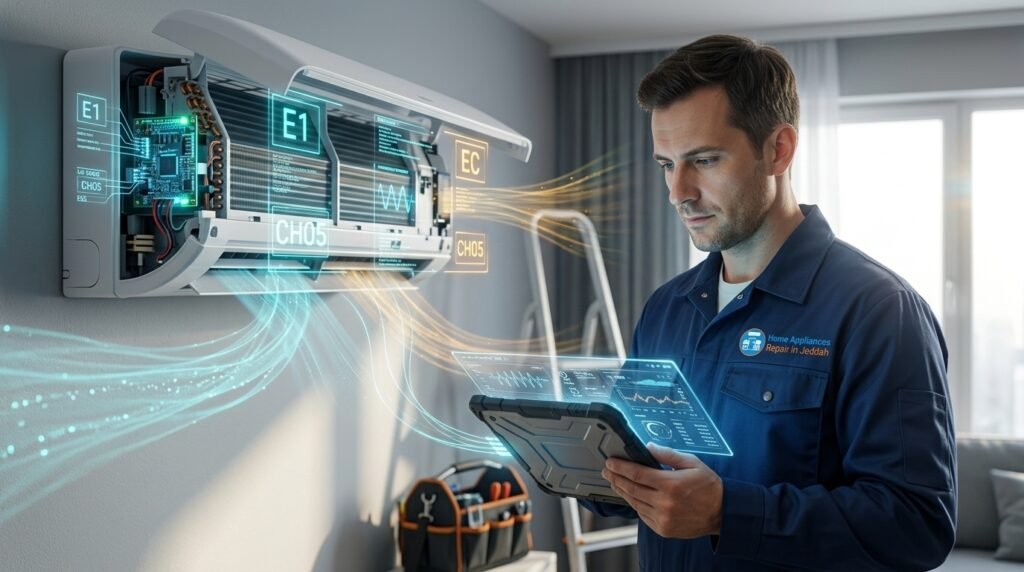
Following a structured approach to Understanding AC Error Codes: What They Mean helps you decode the most common fault symbols across Saudi homes safely. Different brands group their codes by prefix: E1 / CH05 usually signals indoor-to-outdoor serial communication loss; E4 / P4 points to dangerously high compressor discharge temperature; F1 / F2 indicates an open or shorted indoor evaporator or ambient sensor; H6 / CH10 means the indoor blower fan motor has stalled; and EC / CH38 warns of refrigerant leakage.
While homeowners can safely perform a hard power reset and clean blocked air filters, any code that returns immediately after restarting requires professional electrical testing.
What to Do First
The moment your air conditioner stops cooling and flashes an error code, take a clear photo of the indoor LED screen with your smartphone. If the unit uses blinking indicator lights instead of numbers, count the exact number of flashes and the pause length between cycles. Next, turn the system off with the remote control and switch off the dedicated wall circuit breaker for five full minutes. While the power is off, slide out the indoor mesh air filters, rinse away accumulated dust under tap water, let them dry, and restore power to see if the code clears.
Tools, Documents, or Prerequisites Required
Technicians applying Understanding AC Error Codes rely on specialized diagnostic equipment to pinpoint faults without guesswork. Essential tools include a true-RMS digital multimeter with diode, capacitance, and kilo-ohm resistance modes, an insulated non-contact voltage detector, and a digital clamp ammeter. For temperature and airflow verification, we use an infrared thermometer alongside a cup of ice water to test thermistor resistance shifts at zero degrees Celsius. Always locate the unit’s silver rating plate on the side of the indoor cabinet to record the exact brand, model number, and refrigerant type before calling for technical service.
Expert Strategies for Maximum Value
When managing these projects for residential compounds and commercial offices in Al Basateen and Al Murjan, we prevent recurring AC error codes through three targeted upgrades. First, we install an automatic single-phase voltage protector with a three-minute time delay at the wall breaker to eliminate P-series inverter board faults during summer grid fluctuations. Second, we coat outdoor communication terminal blocks with dielectric silicone grease to block coastal salt oxidation. Third, we clear drain float switches and deep-clean coils during our preventative seasonal AC maintenance plans in Jeddah, stopping E-series and F-series lockouts before peak heat arrives.
Top Mistakes to Avoid
Homeowners and untrained maintenance workers frequently make three costly errors when dealing with blinking AC displays. First, never tape down or bypass a condensate float switch to clear an E5 or E8 water-full error code; doing so causes contaminated drain water to overflow straight down your interior drywall. Second, never twist broken thermistor wires together without soldering and heat-shrinking the joint, because extra wire resistance tricks the PCB into reading the wrong temperature. Third, never top up refrigerant gas to clear an EC code without finding and brazing the copper pinhole leak first.
Mistake 1 and Exactly How to Prevent It
The single most destructive mistake we see across Jeddah properties is flipping the wall circuit breaker off and on five or six times in a row when an air conditioner displays a compressor drive or overcurrent code like P4, H5, or CH21. Every forced restart dumps high electrical current into an overheated IPM chip or locked compressor rotor, blowing the main circuit board tracks and charring wiring harnesses. To prevent this expensive damage, only perform one five-minute breaker reset. If the code returns, leave the breaker off and book AC Repair Service In Jeddah immediately.
Maintenance, Longevity, and Long-Term Care
Preventing air conditioner error codes is always cheaper than fixing broken electronic components in the middle of July. Most thermal, fan, and drainage fault codes happen because coastal humidity and fine desert dust choke the indoor evaporator and outdoor condenser coils. When dirt blankets the copper tubing, pipe thermistors cannot read refrigerant temperatures accurately and the outdoor compressor overheats.
Applying the preventative habits in this guide to Understanding AC Error Codes keeps sensors clean, drains flowing freely, and inverter boards cool across ten or more summers.
Daily, Weekly, or Ongoing Best Practices
You can stop over seventy percent of common residential AC fault codes with simple biweekly care. Every two weeks during summer, open the front indoor panel, remove the nylon dust filters, and wash them gently with lukewarm water. Blocked filters starve the indoor coil of airflow, freezing the evaporator pipe and triggering F-series sensor errors or EC false leak alarms. Also, keep your thermostat set at a steady 23 or 24 degrees Celsius rather than 16 degrees, and keep outdoor condensing units clear of storage boxes, plants, or debris that block exhaust heat.
Insider Hack for Long-Term Success
Here is an insider technician trick from our field playbook on Understanding AC Error Codes that stops false indoor pipe sensor faults (F1, F2, or CH02) in humid coastal homes. Inside the indoor unit, the copper pipe thermistor slides into a small cylindrical copper sleeve brazed to the evaporator bend. Over time, condensation and vibration loosen the retaining clip, creating an air gap around the sensor bulb so the PCB misreads coil temperature. During routine maintenance, have your technician pack the sensor sleeve with thermal conductive paste and secure the clip tightly for instant, accurate temperature readings.
Comparing Alternative Options
When your air conditioner flashes a fault code, you generally face three choices: trying to decode and repair the unit yourself using generic online forums, calling a low-cost uncertified street worker, or hiring a licensed HVAC diagnostic specialist. While basic filter washing and a single breaker reset are completely safe for homeowners, opening an energized inverter cabinet exposes you to 380-volt DC shock hazards. Knowing how traditional guesswork compares against modern instrument-backed diagnostics helps you protect both your safety and your cooling investment.
Traditional Methods vs Modern Solutions
Traditional AC repair relied on trial and error: mechanics would cut out thermistors, short-circuit safety switches, or pump random amounts of gas into the suction line hoping the blinking light would turn off. On modern inverter units, those outdated tricks fail instantly and trigger secondary motherboard lockouts. Modern solutions rooted in Understanding AC Error Codes utilize manufacturer service software, acoustic smartphone telemetry, digital micron gauges, and precise kilo-ohm resistance tables. Certified technicians test every sensor and relay circuit mathematically before replacing a single part, guaranteeing a permanent fix on the first visit.
Why the Recommended Solution Wins
Professional instrument-based diagnostics win every time because they solve the actual electrical or mechanical trigger behind the code. When a trained technician verifies thermistor curves, cleans corroded communication lugs, and charges refrigerant by exact digital weight, your air conditioner returns to its original factory energy efficiency. You avoid paying for unnecessary circuit board swaps, prevent repeat mid-summer shutdowns, and cut monthly electricity waste by up to twenty-five percent. Investing in verified diagnostic expertise restores icy, whisper-quiet airflow and gives you complete peace of mind during the hottest Red Sea afternoons.
Geographic, Legal, and Compliance Rules
Servicing air conditioning electronics and pressurized refrigerant systems in Saudi Arabia requires strict compliance with national building and environmental standards. High coastal salinity in districts like Obhur Al Shamaliyah and Al Shati accelerates metal corrosion, while high summer grid loads demand properly rated electrical breakers and grounding wires.
Following local mechanical codes during Understanding AC Error Codes diagnostics protects your villa or commercial building against electrical short circuits, toxic refrigerant fumes, and voided manufacturer warranties.
Navigating Local Regulations or Industry Standards
All residential and commercial HVAC repairs in the Kingdom must follow the Saudi Building Code (SBC 501 Mechanical) and SASO 2663 energy efficiency directives. When an error code like EC or CH38 indicates a refrigerant leak, technicians are strictly forbidden from venting R410A or R32 gases into the outdoor air and must use certified recovery cylinders. Additionally, indoor air quality and chemical coil sanitizing during drainage fault repairs should align with EPA indoor air quality guidelines to keep living spaces safe for children and elderly residents. Dedicated 4mm² copper supply lines and grounded disconnects are mandatory.
Essential Safety or Risk Mitigation Protocols
Safety is paramount whenever troubleshooting electrical or refrigerant fault codes. Before touching any internal wiring to clear an E-series or P-series fault, technicians must execute Lockout-Tagout (LOTO) at the breaker panel and confirm zero direct current voltage across the inverter main capacitors using a calibrated voltmeter. Furthermore, many modern split units run on R32 difluoromethane, an A2L mildly flammable refrigerant. When fixing a refrigerant leak code, technicians must purge the copper lines with dry nitrogen before brazing and test the indoor evaporator with an A2L-rated electronic leak detector before restoring power.
Conclusion and Summary
A blinking alphanumeric code on your air conditioner is not a death sentence for your cooling system—it is a built-in roadmap pointing directly to the component that needs attention. By mastering Understanding AC Error Codes: What They Mean, you can instantly tell whether your unit needs a simple filter wash and five-minute breaker reset or urgent professional servicing for a communication fault, failed thermistor, or refrigerant leak. Combining regular coil maintenance with certified diagnostic care protects your inverter electronics and keeps your indoor spaces comfortably cool all year round.
Final Recap of Value
Keeping this guide to Understanding AC Error Codes handy empowers you to respond calmly whenever an E1, E4, F1, H6, EC, or CH warning flashes on your screen. You now understand how onboard NTC sensors and inverter PCBs monitor system health, why coastal humidity in Jeddah causes communication terminal oxidation, and why repeated breaker resets risk burning out expensive compressor drives. Asking your technician the right evaluation questions and insisting on multimeter verification ensures you only pay for the exact repair your air conditioner actually needs.
Next Steps for the User
Do not let a blinking fault code leave your family or business sweating through another humid afternoon. Whether your Gree, LG, Samsung, Carrier, Midea, or Daikin air conditioner is flashing an error code, leaking water, or blowing warm air in Al Khalidiyah, Al Zahraa, Al Shati, or Obhur, expert help is ready right now. Book your inspection through AC Repair Service In Jeddah for fast, same-day diagnostics across all Jeddah neighborhoods. Our certified technicians arrive with genuine replacement sensors, PCB repair gear, and transparent upfront pricing to restore icy cooling today.
Frequently Asked Questions
Homeowners and property managers across Jeddah ask our service desk every day how to interpret sudden blinking lights and alphanumeric codes on their split and central air conditioners. Because each manufacturer programs its own diagnostic table, Understanding AC Error Codes means knowing both universal prefix patterns and brand-specific resets. Knowing which quick checks you can safely do at home and when to shut off the main breaker protects your appliance from permanent damage. Below, our lead field technicians answer the five most common questions about air conditioner error codes.
Top Queries Answered
- What do E1, E2, E3, and E4 error codes usually mean on an AC? On most split units (like Gree and Midea), E1 signals indoor-to-outdoor communication failure or high pressure, E2 indicates indoor evaporator freeze protection, E3 points to low refrigerant pressure, and E4 warns of dangerously high compressor discharge temperature.
- How do I clear an error code on my split air conditioner? Turn the unit off with the remote, switch off the dedicated wall circuit breaker for five full minutes to discharge the PCB capacitors, clean the air filters, and switch the breaker back on.
- What does the EC or CH38 error code mean? Both codes indicate refrigerant leakage or low gas pressure detected by the evaporator coil temperature sensors, requiring leak brazing and a weighed refill.
- Why does my AC show an F1 or F2 code after cleaning? Water or hand pressure likely loosened or shorted the indoor room air thermistor (F1) or copper evaporator pipe sensor (F2) plug on the circuit board.
- Is it safe to keep resetting the breaker when an AC error code appears? No. Resetting the breaker more than once on a compressor or IPM error (like P4 or CH21) can permanently burn out the motherboard and compressor windings.
Final Bonus Tip for the Reader
Take a clear smartphone photo of the wiring schematic and error code legend sticker glued to the inside of your air conditioner’s front electrical cover the next time you wash your filters. Heat and coastal humidity often cause these paper stickers to peel off or fade after a few years, leaving technicians without the factory board diagram. Saving a digital copy on your phone makes Understanding AC Error Codes effortless and helps your technician identify the exact thermistor resistance values and pin layouts in seconds during any future repair visit.
Final Thoughts: Reliable air conditioning is non-negotiable for safe, comfortable living across Jeddah’s intense coastal climate. When your cooling unit stops running and flashes a mysterious error code, panic and guesswork only lead to bigger repair bills and damaged inverter boards. By pairing the practical diagnostic steps in Understanding AC Error Codes: What They Mean with licensed professional care, you protect your compressor and restore cold airflow fast. Trust the certified specialists at AC Repair Service In Jeddah for accurate code diagnostics, genuine replacement parts, and guaranteed workmanship. Reach out to our local team today to book your service visit and keep your property cool all year long.